

Flu season is off to its earliest start in years, and activity is very different from state to state. The regional editions cover what’s happening where you live, across flu, Covid-19, RSV and more. Try them free for 7 days, then get any or all four regions every week through the winter for $5 a month or $60 a year. Cancel online anytime. Learn more about regional editions.
Influenza
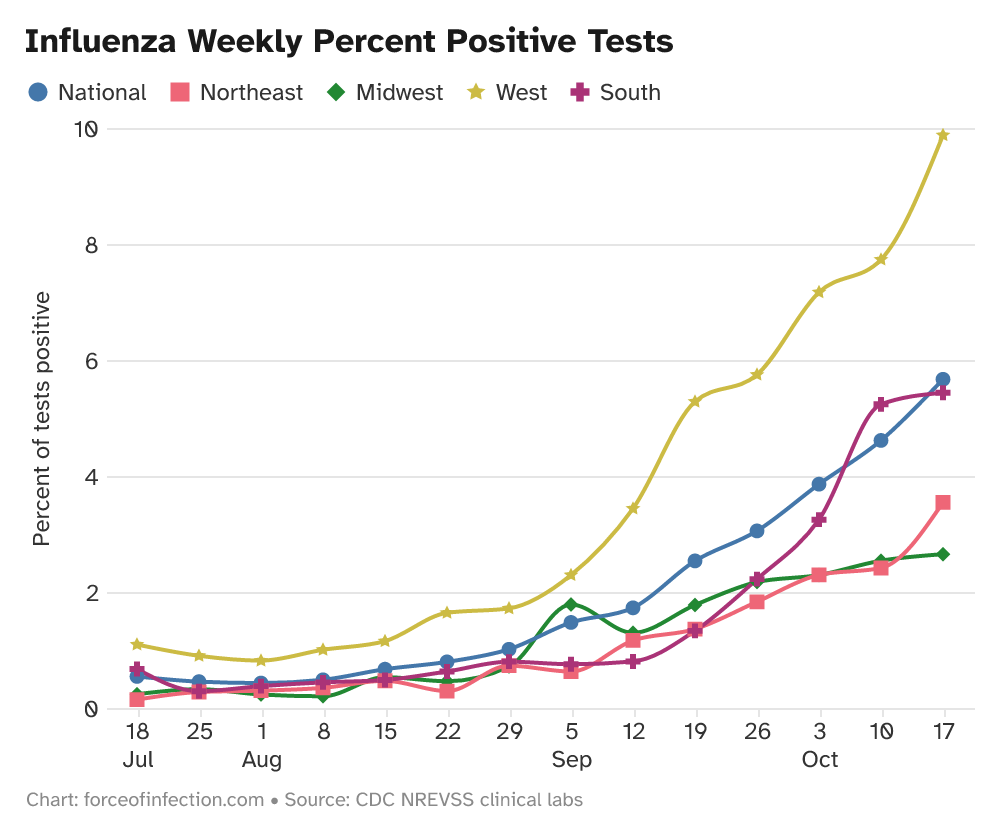
Influenza activity continues to rise across the country, with the West and South both seeing substantial activity, especially compared with a typical October.
Test positivity continues to rise in the West, now near 10%. The region got a very early start to the season. The South is now well on its way, too, with nearly 5.5% test positivity. The other regions are in better shape, but increases are still evident. Outpatient influenza-like illness is ticking up more slowly, rising to 2.2% at the national level from 2.1% the week prior.
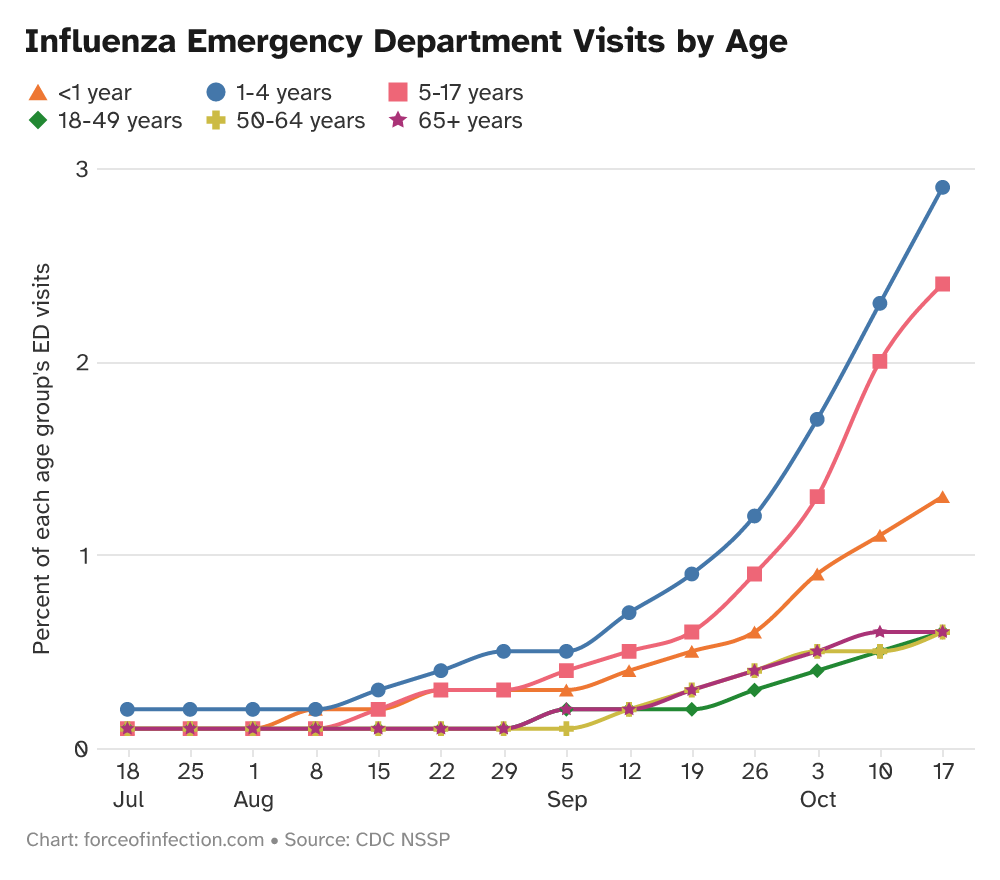
I wanted to focus on age today, since there are some notable patterns. Children ages 1-4 and 5-17 have the highest percent of visits to the ED for influenza, currently between 2-3%. However, this partly reflects the fact that adults visit the ED more often for other reasons, such as chronic illness, so flu makes up a smaller share of their visits.
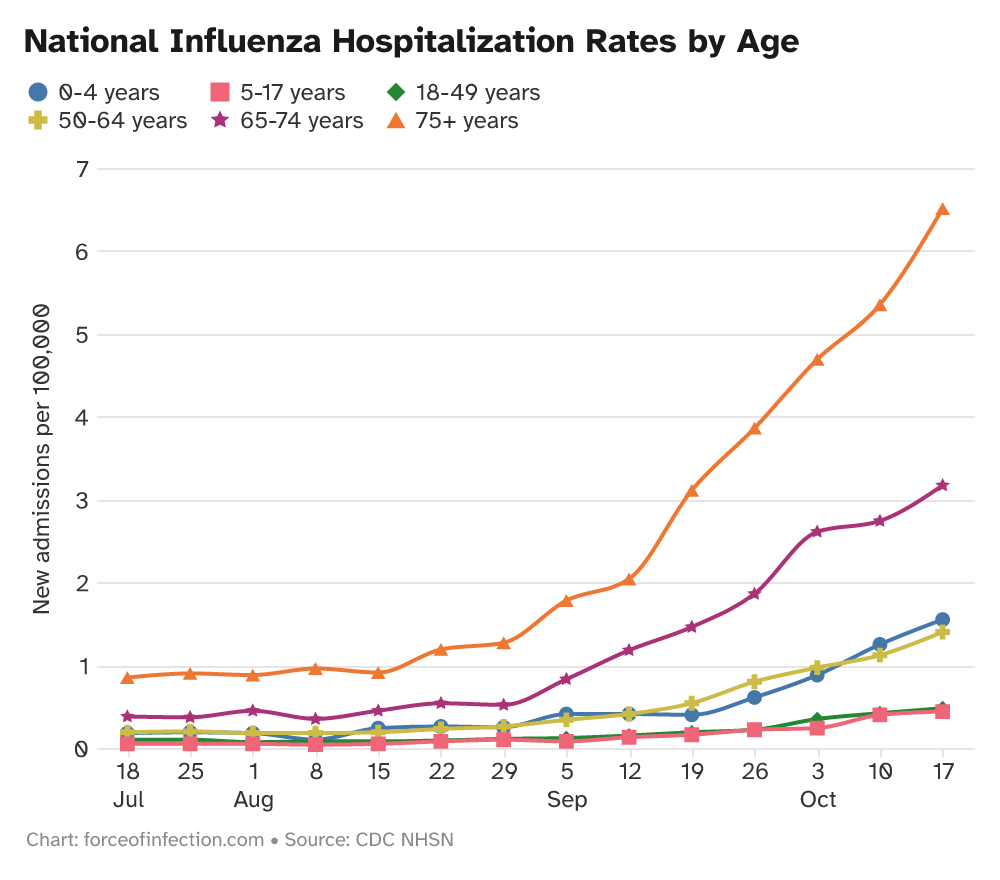
This is why we see a big flip when we look at hospitalization rates. Older adults, particularly those aged 75 and over, have the highest rates of influenza hospitalization by far, now over 6 per 100,000 and climbing. This is why it's especially important for older adults to get vaccinated as soon as possible.
COVID-19
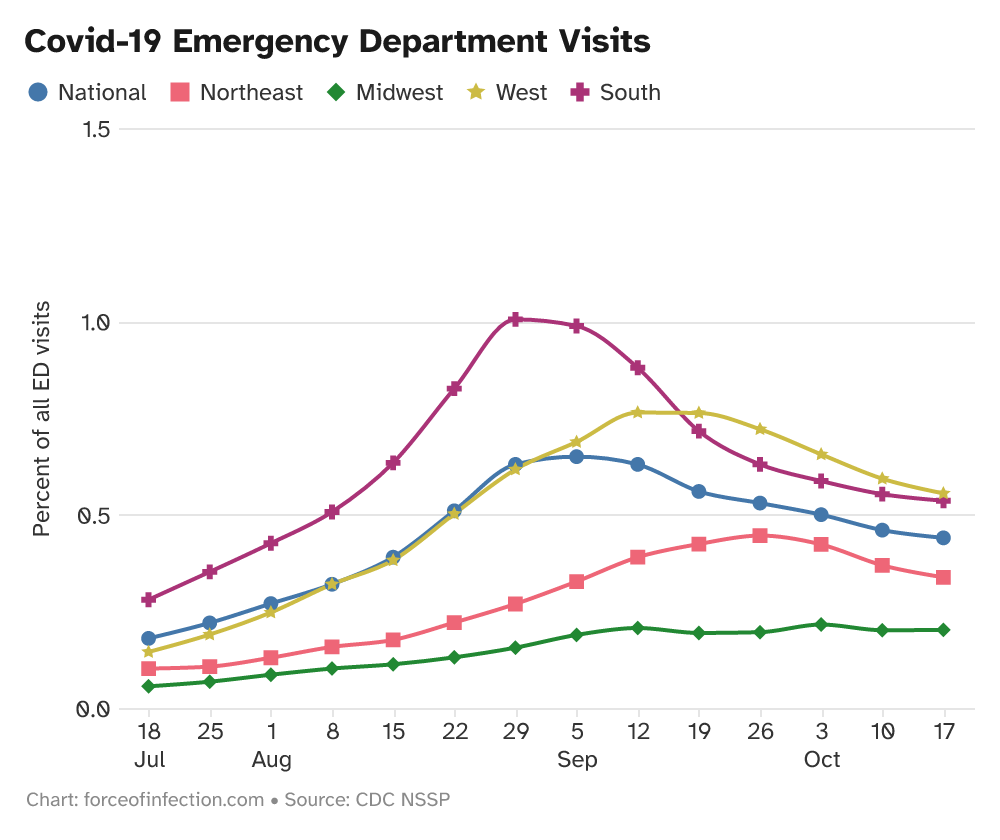
Covid-19 activity is pretty modest right now. The Northeast is a bit of an exception. Covid-19 admissions there have held near their peak for three weeks and still outnumber flu admissions. The Midwest has the least Covid-19 activity of the four regions.
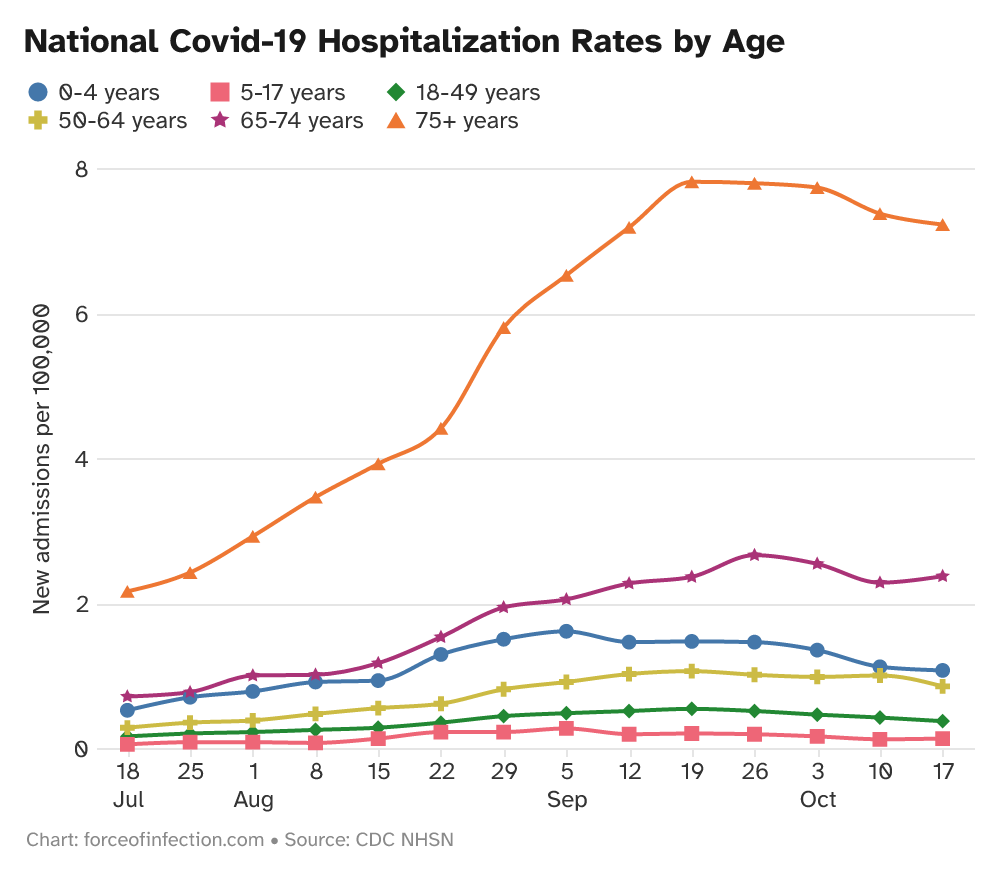
Adults 75 and older continue to have by far the highest hospitalization rate, at 7.2 per 100,000, much higher than the rate for adults 65 to 74. Among young children, Covid-19 ED visits are higher than this time last year: 0.9% of visits among children ages 1 to 4, compared with 0.4% a year ago.
RSV and other respiratory pathogens
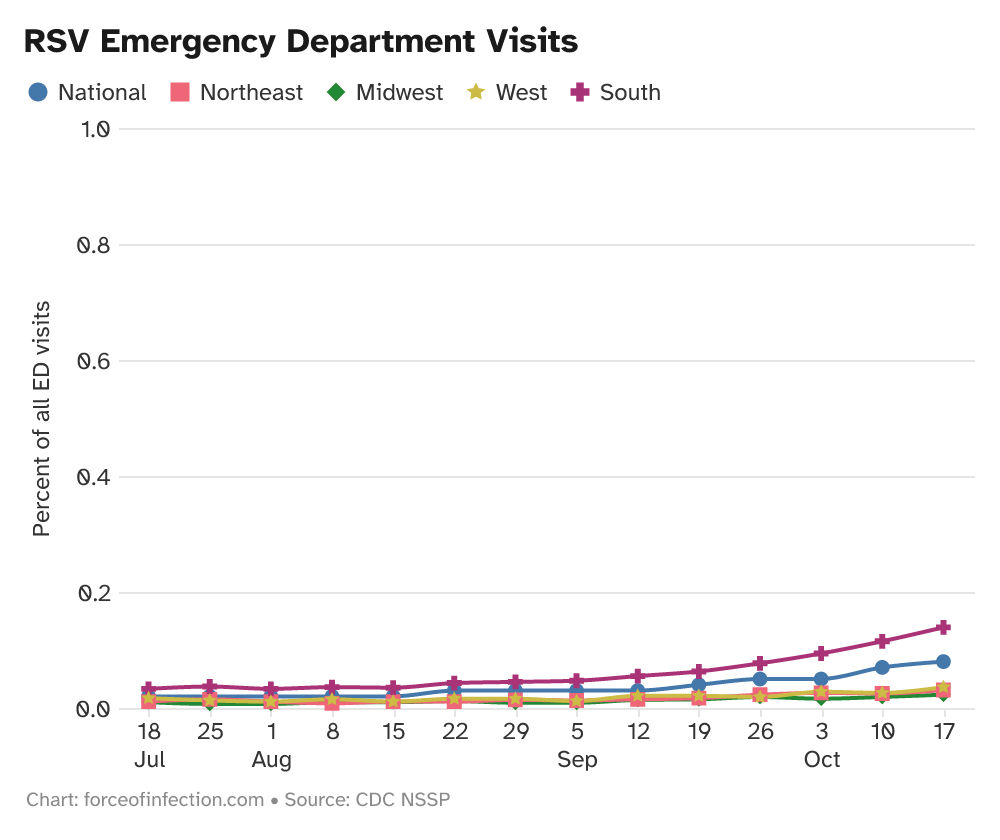
RSV activity remains low nationally, but its usual autumn season is underway, on schedule. Hospital admissions for RSV have risen six weeks in a row and are a little above this time last year, led by young children in the South. Among children under 5, the admission rate rose from 1.8 to 2.4 per 100,000. RSV accounts for 0.9% of ED visits among infants under 1 and 0.8% among children ages 1 to 4.
Wastewater levels of enterovirus D68 (EV-D68), which can cause severe respiratory illness in children, especially those with asthma, are high in all four regions, according to WastewaterSCAN. EV-D68 was tentatively linked to acute flaccid myelitis, a polio-like illness, after outbreaks in 2014, 2016 and 2018. However, several years of significant EV-D68 circulation have passed with no matching AFM surge.
Stomach Bugs
Norovirus test positivity remained flat at 8.5%, but other sources suggest it is starting to climb: norovirus detections on BioFire's hospital testing panels have risen for four straight weeks, to 12.2%, and wastewater levels are high and rising nationally, according to WastewaterSCAN. Rotavirus activity is low and stable.
Food Recalls
New:
- Coffee & Vanilla Gelato from Gelatelli (Lidl US) (more info)
- Hot Dogs, Bacon, Sausage and Deli Meats from Kayem Foods (more info)
- Raw Oysters from Little Wicomico Oyster Company (more info)
Previously Reported:
- Raw Mild Cheddar Cheese from Family Farmstead (more info)
- Broccoli Seeds - Calabrese from Eden Brothers (more info)
- Broccoli Sprouting Seeds from Gardeners Basics (more info)
- Cold Smoked Salmon, Halibut, and Trout from Starfish Seafood (more info)
In Other News
- The large Ebola outbreak in the Democratic Republic of the Congo has spread to two more countries. Kenya has confirmed nine cases, all linked to a traveler who fell ill in the DRC and died shortly after arriving in Nairobi in early October. The other eight cases are close contacts, including relatives and health workers who cared for the first patient. The Ministry of Health says all 135 contacts have been traced and there is no evidence of community transmission. Nigeria has also confirmed its first case, in a woman in Abuja who had recently traveled from Uganda. Forty-four of her contacts are being monitored. Epidemiologists are investigating how she may have been exposed, given that Uganda is not known to have active transmission. The DRC has reported 9,735 confirmed cases and 4,690 deaths as of October 21. There is no approved vaccine or specific treatment for Bundibugyo virus, though clinical trials are underway.
- France has reported the first known human infection with Shamonda virus, a midge-borne virus that has been spreading among cattle in Europe this year. The patient was severely immunocompromised. The person was likely bitten by an infected midge in eastern France, and died in October. Investigators haven't determined whether the virus caused or contributed to the death. The virus is a close relative of Schmallenberg virus and was not previously known to infect people. It has been detected in dairy herds in eastern France since late July and has since spread to dozens of departments and several other European countries. French health and agriculture officials say no risk to the general population has been identified.
- The second set of regional editions of the season went out to paid subscribers earlier today. Regional editions contain detailed, state-level information about flu, Covid-19, RSV and more.
- If you would like to receive regional editions for $5/mo, follow these instructions. You can cancel online any time.
- If you were expecting a regional edition but did not receive it, begin by checking your spam folder. Then, confirm your regional selections using these instructions. If you're stuck, write to support@forceofinfection.com. (Please be courteous! I promise we will do our best to solve your problem.)
- Paid subscribers can view regional editions online anytime at forceofinfection.com. Here are the direct links to today's for easy access: South | West | Northeast | Midwest