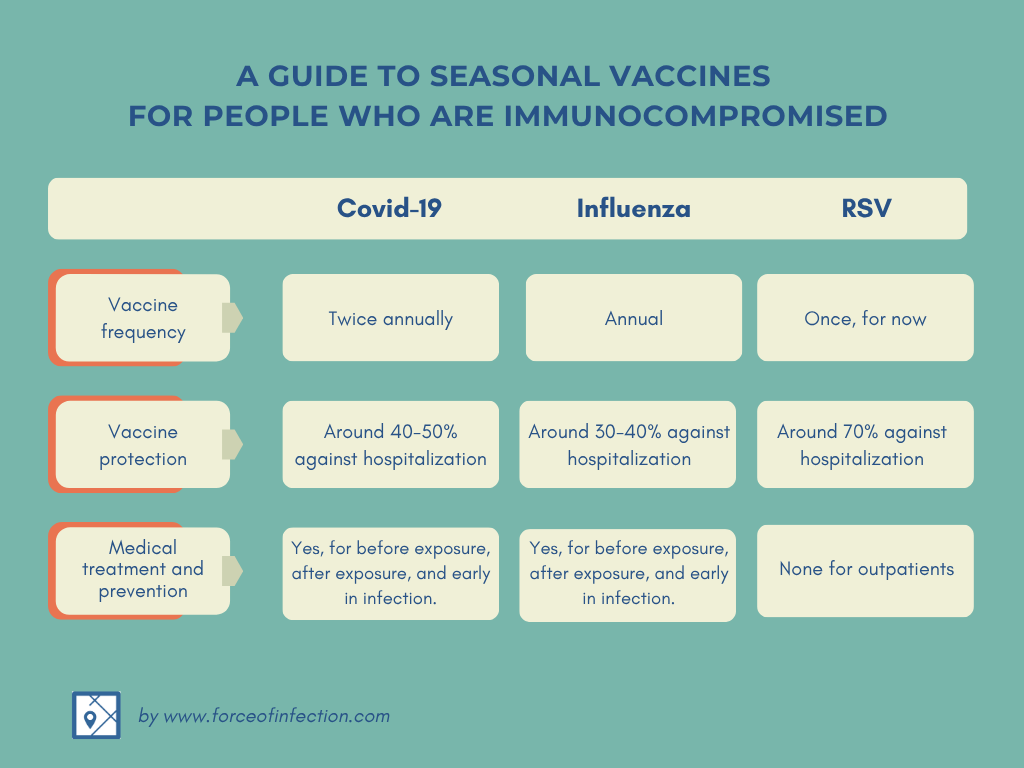
As I shared in my recent State of the newsletter update, I want to spend more time on immunocompromised (IC) readers, who are often left out or brushed aside in public health updates. So, I put together an IC guide to seasonal vaccinations using information from reputable sources. Most of it summarizes 2025 guidance developed by the Infectious Diseases Society of America, a professional organization of infectious disease doctors. Other sources are linked within. This post is free for everyone, so please share.
Force of Infection is a reader-supported publication. To support this work, consider upgrade to paid.
Covid-19
Bottom line: Get vaccinated every year. For people who are immunocompromised, a second dose (given at least two months after the first) is likely to make protection last longer. You do not need to show documentation to prove you are eligible for a second dose; self-attestation is acceptable.
Vaccine protection: IDSA’s committee reviewed published studies and found that Covid-19 vaccines are approximately 37-46% effective at preventing hospitalization and 61% effective at preventing death in people who are elderly or immunocompromised (a second review by another group yielded similar findings). Protection against milder illness, as measured by outpatient visits, was lower at around 21-40%. These numbers should be treated as loose estimates because protection also depends on how well the vaccine matches circulating variants, which varies from year to year.
The committee notes that these estimates are likely high, because the studies they reviewed only followed participants for a short period and thus did not account for the fact that protection fades over time. This caution is supported by a 2024-2025 study from the Veterans Health Administration, which found that in older adults (average age of 71), vaccine effectiveness was only 17% against confirmed infection, 21% against emergency department or urgent care visits, and 20% against hospitalization. Although vaccine effectiveness faded over time, protection against death remained high.
Medicines to prevent and treat Covid-19: There are several options. The important thing is that these drugs must be started as soon as possible to be effective.
- Prevention: Pemgarda is a monoclonal antibody given before an exposure or infection. It is approved for use in people who are moderately or severely immunocompromised.
- After exposure: There is a new product called Xocova that helps to prevent infection, if given within three days of an exposure.
- Treatment: There are several treatment options for people who are infected and at risk of developing severe disease, including Paxlovid, Veklury, and Lagevrio. All are used early in the course of illness.
Influenza
Bottom line: Get vaccinated every year. High-dose or adjuvanted vaccines are likely more effective for older adults and people who are immunocompromised. Live-attenuated vaccines (i.e., the nasal spray) are not recommended.
Vaccine protection: Direct evidence in immunocompromised adults found about 32% protection against influenza hospitalization. Because IC-specific data are sparse, IDSA also considered studies in older adults that found roughly 42% effectiveness against hospitalization and 53% against all-cause death. Separately, a CDC summary of data from the 2022-2023 season estimated 32-49% protection for people who are immunocompromised. As with Covid-19, how well the influenza vaccine works depends on whether the vaccine is a good match for what is circulating that season, which varies from year to year.
Medicines to prevent and treat influenza: There are several options for prevention and treatment of influenza, including Tamiflu, Relenza and more. As with drugs for Covid-19, these drugs must be given as soon as possible to be effective.
RSV
Bottom line: Quoting here from IDSA, “all immunocompromised individuals aged ≥18 years should receive the RSV vaccine. For immunocompromised patients <18 years, administration should be guided by shared decision making.” The vaccine is given just once, not annually. However, the guidance may someday be updated to recommend additional doses if protection is found to wane.
Vaccine protection: The committee reviewed studies that found around 70% protection against hospitalization in immunocompromised adults. In older adults, the RSV vaccine offered 81% protection against critical illness. There was no data on how well the vaccine protects against less severe illness or death.
Medicines to prevent and treat RSV: There are no antiviral treatments for outpatient use.
General notes
Co-administration: The vaccines can be given at the same time, according to IDSA, CDC, and a recently published study.
Getting access to treatment: Although there are treatment options for both flu and Covid-19, I have heard from many readers that they struggle to figure out the steps to get access (a task not made easier by feeling crummy). I recommend thinking ahead about what you will do if you are exposed or infected. For instance, ask your doctor if they see antivirals as options for you. Ask if they require diagnostic testing first, and how to get that done quickly. How would you get a test or prescription on the weekend? Does your usual pharmacy keep the drugs on hand or would they need to be ordered? Does your insurance carrier cover the cost, and what is your copay? A little pre-work now will make things smoother down the road.
Household members: Eligible household members and close contacts should also be vaccinated. This is meant to provide something of a wall of protection around the person who is vulnerable. There is not much data about how well this works, but the principle is sound.
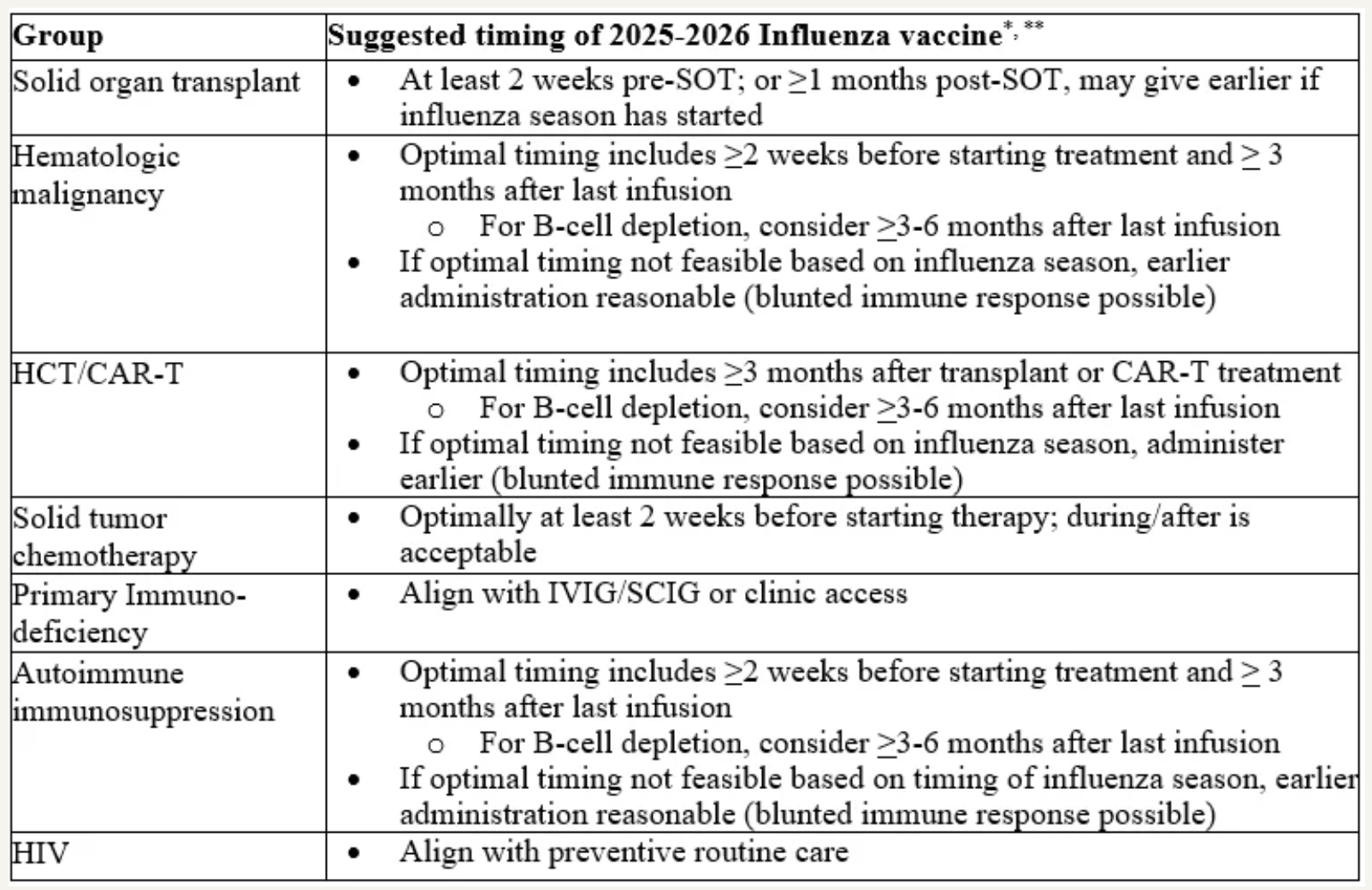
Timing considerations: For people in treatment (e.g., chemotherapy, recent transplant), there are special considerations around when the vaccines should be given because treatments can impact effectiveness. Responsibility for deciding when to vaccinate is shared by the specialist and the primary care doctor. I’m including a table from IDSA to give you a sense of the recommended schedules, but really this needs to be a conversation with your doctor.