


Welcome to Outbreak Outlook! This is the free, national version. Paid subscribers can access regional editions of the newsletter, which contain more local information.
Not signed up yet but interested in getting the regional insights? Subscribe and follow these easy instructions at this link.
Respiratory diseases
Influenza-like illness
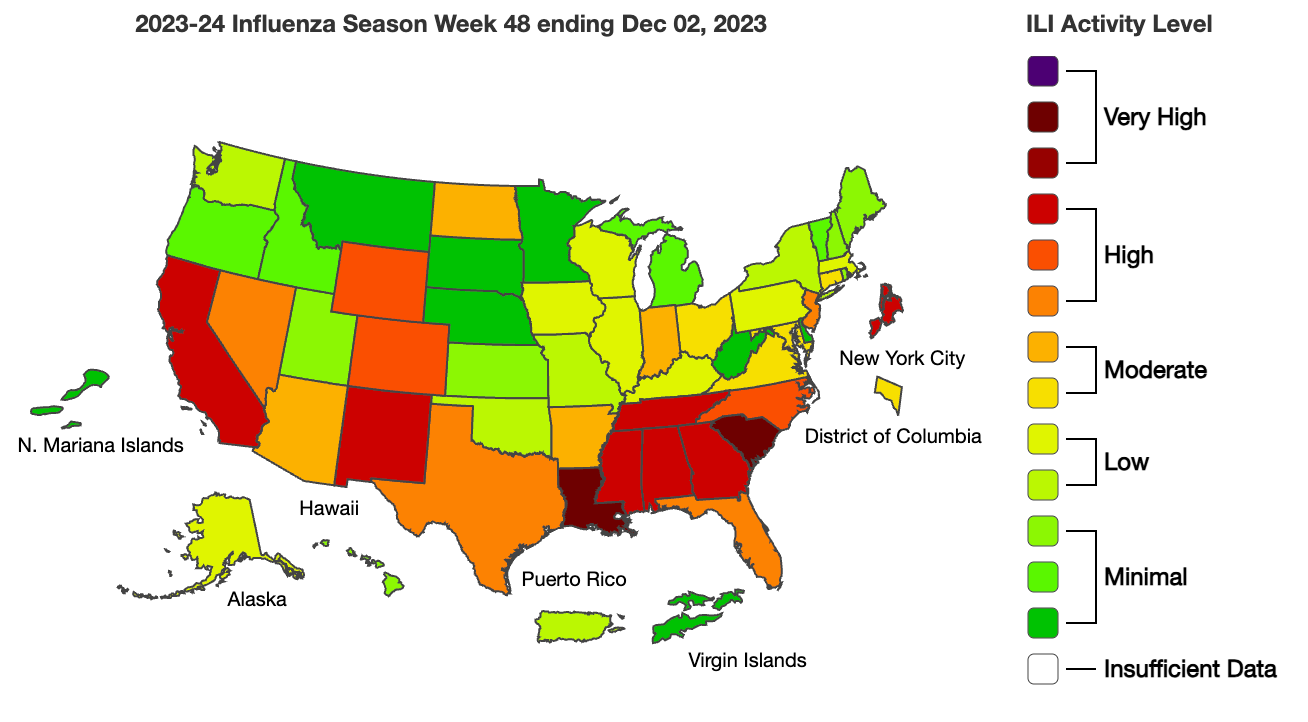
Influenza-like illness (ILI) is still rising, with 4% of visits to the doctor for fever and cough or sore throat nationwide. We’ve been in flu season for about five or six weeks now, with more still ahead.
By region: ILI activity remains most intense overall in Southern states, but the whole country is seeing increases. Louisiana and South Carolina currently have "very high" levels of activity. Fourteen states across the country are in the “high” category, including New York City and California. The Midwest and Northeast remain mostly in the “low” categories, but I expect that to change in the weeks to come.
By severity: Hospitalizations and deaths to influenza are also rising, though numbers are currently far below what we saw last year. During the week ending December 2, there were around 4,800 new hospitalizations nationwide. Older adults (65+) are at highest risk of hospitalization. [Edit: the e-mailed version of the post said there have been no pediatric deaths so far this season. That is incorrect.]
By age: For once, kids caught a bit of a break when it comes to ILI activity. The percentage of visits to the doctor in the 0-4 age group remained flat at 11.1%, and fell slightly to 5.7% in the 5-24 age group. Unfortunately, activity in older age groups is rising, particularly in the 25-49 age group (now at 3.6%).
Covid-19
Covid-19 activity is still increasing in every region of the country. The Midwest region is most affected, with the number of weekly new hospitalizations per 100,000 rising from 7.6 to 9.1. States like Indiana and Iowa saw sizable upticks of 2-3 new admissions per 100,000, which is a pretty brisk increase.
Other regions of the country remain somewhat better off, with hospitalization rates below 7.5. The South currently has the lowest levels of Covid-19 activity, but numbers are increasing there too. Wastewater concentration is also increasing in every region, again with the Midwest being hardest hit.
Taken together, this suggests to me that we are in the now-annual winter Covid-19 wave. This wave doesn’t seem to be quite as energetic as previous winters though, so I hope it turns out to be a small one. Activity usually peaks in January and then declines through spring.
RSV
RSV activity has dipped slightly in the past week, down to 11.7% PCR test positivity from 12.7% last week. Antigen test positivity is down too, which I take to be a good sign.
I expected the South will be the first region to peak because the season began there. And indeed, test positivity in the South has declined for two weeks in a row, which I take to be another good sign that we are at or slightly past peak season in that region. There are some super early signs that other regions are also turning the corner as well, but it’s too soon to say for sure.
But remember that although declining numbers are good news, it means we are at peak season so activity is about as high as it gets!
Others
I’m monitoring several other respiratory viruses.
- Human metapneumovirus, parainfluenza, and adenovirus are holding steady at low levels nationally.
- Seasonal coronavirus levels remain relatively low nationally, but activity haas increased quite a bit in the South.
Stomach Bugs (Norovirus)
Norovirus (the stomach bug) activity remains quite high, with roughly 10% PCR test positivity nationally. In the plot below you’ll see a slight leveling off in test positivity, but I wouldn’t read too much into that. Norovirus data tends to jump around, and at the regional level there are still signs of steady increase.
The gastrointestinal symptoms tends to be particularly unpleasant, so to try to prevent it, wash your hands often with soap and water and avoid touching your face. To avoid spreading the virus to others, stay at home if you are experiencing gastrointestinal symptoms and avoid preparing food for others until at least 48 hours after symptoms stop.
Food recalls
The following foods are being recalled because they are contaminated. Please check your cupboards and throw out any of these items:
New this week:
- Ready-to-eat chicken breast products under Chef’s Line brand name (more info)
- Ready-to-eat chicken fried rice under Freshness Guaranteed brand name (more info)
Previously reported:
- Tons of cut cantaloupe products. Stay away from cantaloupe for now. (more info)
- Peaches, nectarines, and plums distributed by HMC farms (more info)
- If you have food allergies, you may wish to review these FDA safety alerts and USDA alerts for foods with undeclared allergens
In Other News
- According to a new CDC report, in 2021-2022 about 1.3% of adults in the U.S. were diagnosed with myalgic encephalomyelitis/chronic fatigue syndrome (ME/CFS). Women had a higher likelihood of having ME/CFS compared to men. Prevalence of ME/CFS increased with age, peaking in the 60-69 age group before declining in older adults. The condition was more prevalent among people with lower family incomes and those living in more rural areas. The report does not describe what, if any, of the burden is attributable to Covid-19, but several readers have asked me about updates regarding long covid, so I wanted to pass along this related information.
- An outbreak of mpox in the Democratic Republic of Congo has prompted health alerts from WHO and CDC. This year, the DRC has reported nearly 13,000 cases of mpox, primarily of the clade I variant. Unlike the clade IIb strain that spread through the U.S. and Europe in 2022, clade I is thought to have a higher mortality rate. Recent studies in the DRC have found sexual transmission to be a key factor in the spread of the disease, especially among men who have sex with men.
- Pertussis, also known as whooping cough, is surging in Denmark and the United Kingdom. Pertussis is a bacterial infection that causes severe coughing fits, which can result in a "whoop" sound when the person breathes in. The infection can be deadly in babies and young children, and it’s dangerous for adults as well. A quick look at pertussis data in the U.S. shows an increase here as well—4,621 cases have been reported in 2023 so far, compared to 2,801 in 2022. The Tdap vaccine, which is given in childhood and then as a booster every 10 years, can prevent pertussis as well as tetanus and diphtheria.
