Influenza-like illness
This is a record flu season, one of the worst we have seen in more than a decade.
After an initial peak around the turn of the new year, outpatient influenza-like illness (ILI) activity dropped for a couple weeks—before making an unexpected rebound, rising to 7.8%. This means that around 1 in every 13 visits to the doctor is for fever and either cough or sore throat. This is the highest level since 2002, though the 2009-2010 and 2003-2004 seasons come close.
Where is activity highest?
Most of the Southern region and parts of the Northeast are experiencing very high levels of activity. Texas, Tennessee, South Carolina, New Jersey, Massachusetts, New Hampshire, and Ohio all have outpatient ILI above 10%. New York City (not shown) is the highest of all at 12.8%. The Midwest and West are in somewhat better shape.
Who is most affected?
As usual, children under 4 years old are seeing the highest rates of illness at 16.9% ILI, an increase from 16.2% the previous week. School-age children and young adults (5-24 years) also show high activity at 11.9%, up from almost a whole point from the week prior.
Working-age adults (25-49 years) are seeing more moderate activity at 6.5% (this is still high!), while older adults show progressively lower rates, with those 50-64 years at 4.9% and those 65 and older at 3.2%. All age groups are seeing increases.
Note, however, it’s older adults who are at greatest risk of severe illness. Hospitalization rates are highest in people ages 75+, followed by the 65-74 age group.
Are we sure this is seasonal flu and not H5N1 or Covid-19?
Yes, this is seasonal influenza. Here’s why:
We know it is not H5N1 because public health laboratories took a close look at 3,458 samples this week and none were H5. About half were H1N1 and the other half were H3N2. There is very little flu B circulating right now.
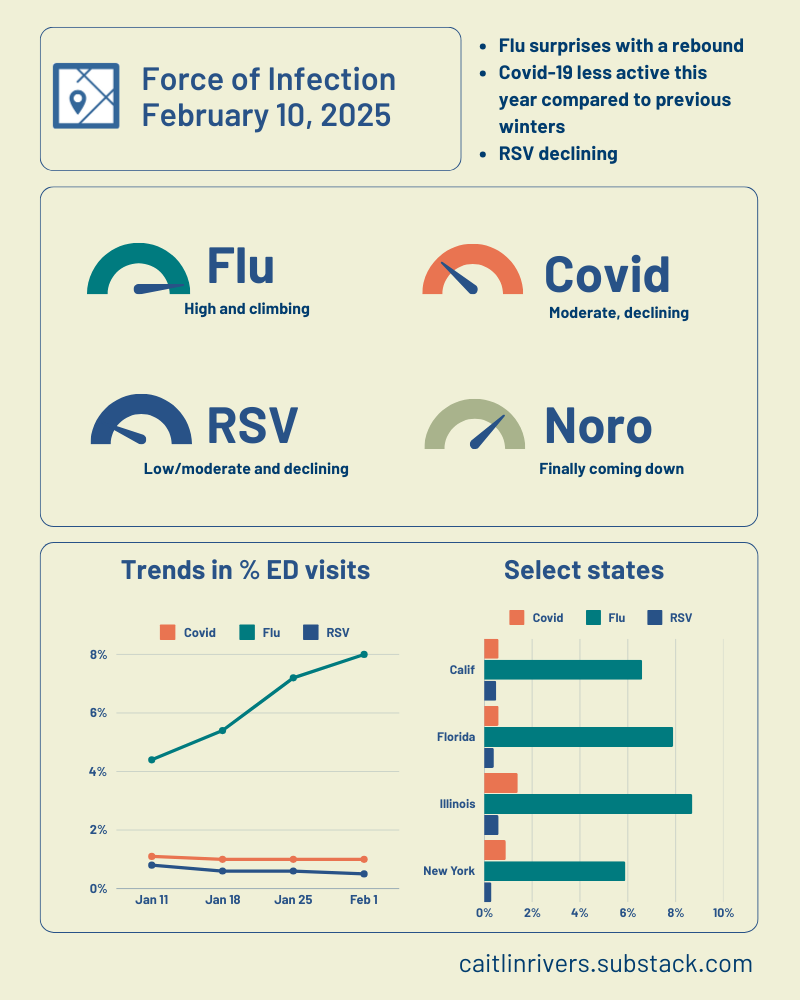
Some readers have noted that outpatient ILI is syndromic (that is, based on symptoms rather than diagnostic tests) and have wondered whether thee heightened activity could actually be Covid-19. While it’s true that syndromic surveillance is nonspecific, multiple lines of evidence support that this is indeed influenza. Wastewater concentration is high, as are emergency department visits (shown below) and hospitalizations for influenza.
How can I prevent influenza?
To prevent influenza transmission, there are several options. Wear a well-fitting mask (like an N95 or KN95) in crowded indoor spaces during flu season. Ventilate indoor spaces by opening windows and using HEPA air filters. When indoors with others, choose larger spaces with good airflow and limit time in crowded settings like packed restaurants or public transit during peak flu activity. These ventilation and crowding measures work alongside basic precautions like getting vaccinated, washing hands frequently, and staying home when sick.
If you do get infected, antiviral medications like oseltamivir (Tamiflu), zanamivir (Relenza), or baloxavir (Xofluza) can help reduce symptom severity and duration if started within 48 hours of symptom onset. These medications work by preventing the virus from replicating, though they don't cure the infection.
In addition to antivirals, treatment involves managing symptoms through rest, staying hydrated, and using over-the-counter medications for fever and pain. Most healthy people recover within 1-2 weeks with supportive care.
And if you are wondering, it is not too late to get a flu shot. We still have at half the season to go, so might as well get protection now if you haven’t already. Coverage is about average this year, with states ranging from around 30-56% of adults. The Southern region tends to have lowest uptake.
COVID-19
Covid-19 activity is moderate for most of the country.
Wastewater activity is high and increased again this past week. The Northeast and the Midwest are tied for regions with the highest activity. However, we aren’t yet seeing wastewater activity translate into severe illness.
Emergency department visits for Covid-19 fell slightly, but remain mostly stable overall. Around 1% of all trips to the ED are for Covid-19, down from a high of 3.4% around the new year. Hospitalizations also held steady at 3.7 hospitalization per 100,000 people.
RSV & Other Bugs
RSV activity is low to moderate and falling in most regions of the country, as measured by ER visits. One exception is the Western region, where activity remains stable. Hospitalizations, too, are falling. Young children ages 0-4 are most likely to be hospitalized for RSV, followed by older adults. Hospitalizations for both age groups are steadily declining.
Human coronaviruses - a common cause of colds - are peaking for a second time this winter. They had peaked at the beginning of January, and now are back up again to the same level. Human metapneumovirus is low, but seems to be ticking up. Other causes of cold- and flu-like symptoms - like adenovirus and rhinovirus/enterovirus are fairy low right now.
Norovirus
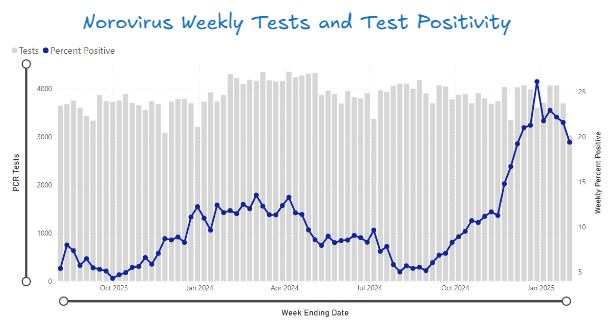
Rates remain unusually high, but it does appear that we have passed the peak. Test positivity decreased this week to 19.4%. This is a a marked improvement from the 26% it hit back in December, though it is still higher than peaks of the past several years. Rates are highest in the Midwest and ‘lowest’ (still high) in the South.
Food recalls
The following foods are being recalled because they are contaminated. Please check your cupboards and throw out any of these items:
New:
- Alfalfa sprouts sold under the Jack and the Green Sprouts brand name (more info)
- Aleppo Tahini Sesame Paste (more info)
- DJ's Boudain sausage links (more info)
Previously reported:
- Blue Ridge Beef Natural Mix [for dogs] (more info). While not for human consumption, humans may be infected with Salmonella if they do not adequately wash their hands or contaminated surfaces after handling the product.
- Wegman’s fully cooked breaded chicken nuggets (more info)
- Casa Mamita frozen chicken and cheese taquitos (more info)
- If you have food allergies, you may wish to review these FDA safety alerts and USDA alerts for foods with undeclared allergens.
In other news
Good news: After a couple weeks of disruption, the CDC data streams I use to produce this report have all been restored and updated.
The World Health Organization reports that the Ebola Sudan outbreak in Uganda, has grown to 7 confirmed cases, up from 2 at last report. The index case, a 32-year-old male healthcare worker, developed symptoms on January 19 and died 10 days later. His wife is among the confirmed cases. Health officials have identified 298 contacts linked to two main clusters: a family cluster and a healthcare facility cluster. The U.S. CDC issued a Health Alert, though no suspected or confirmed cases have been reported outside Uganda. The CDC also raised its Travel Health Notice to Level 2, advising travelers to take enhanced precautions.
An outbreak of Marburg virus disease has been declared in Tanzania. The first confirmed case died on January 19, but an epidemiological investigation found that the outbreak likely began in December or early January. As of January 31, ten cases have been reported. All ten have died. According to WHO, 241 of 281 contacts completed their follow up, with no new cases identified.
At least four cattle herds in Nevada have tested positive for the H5N1 bird flu strain D1.1, a variant previously unseen in cows but linked to a fatal human case in Louisiana. Infected Nevada herds, located in Churchill County, were detected through state investigations and milk testing.
The discovery challenges earlier assumptions that bird flu spillovers into cattle are rare, as all previous cattle cases had been attributed to the B3.13 strain.
Unlike B3.13, which so far has caused only mild symptoms in humans, D1.1 has been associated with more severe illness.