


Welcome to Outbreak Outlook! This is the free, national version. Paid subscribers can access regional editions of the newsletter, which contain more local information. Not signed up yet but interested in getting the regional insights? Subscribe and follow these easy instructions at this link.
Respiratory Diseases
ILI
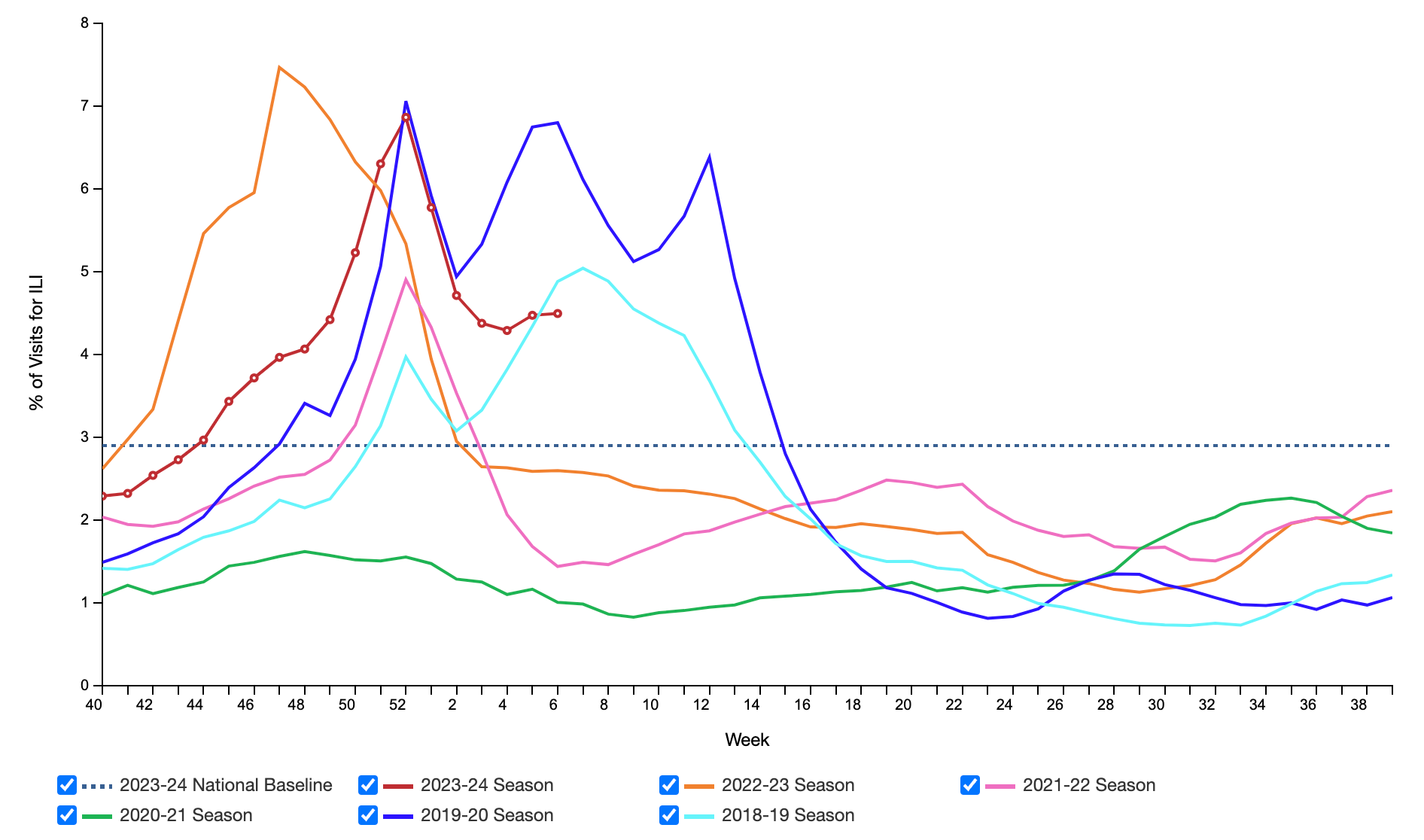
Influenza-like illness remained about the same this week, with 4.7% of visits to the doctor for fever and cough or sore throat. This is above the baseline of 2.9% that marks flu season. Current activity is a mix of influenza A, which is more common in the winter months, and influenza B, which is more often associated with springtime.
By age: Activity continued to increase in the 0-4 and 5-24 age groups to 10.4% and 7.3%, respectively. And as I suspected, what I think of as the parents-with-young-kids age group (25-49) also registered an increase. It’s fairly common to see ILI trends rise first in children and then spread to adults, which is what I am seeing this week.
By region: More than half of the country, 27 states, is seeing high or very high levels of ILI activity. The South is most heavily affected and activity is still rising, but parts of the Midwest are also now seeing increases after a relatively mild start to the season. New York City and Washington D.C. are also in the very high category. It’s a little uncommon for flu to make a second stand like this, so it’s worth keeping an eye on trends in the weeks to come (watch this space!).
By severity: Although outpatient ILI is being stubborn, emergency department visits for influenza are declining, and so is the number of new influenza hospitalizations. Even the beleaguered 5-17 age group saw a tiny dip in ER visits, if you squint a bit (8.5% to 8.1%).
Covid-19
The national picture on Covid-19 hospitalizations is complex, with some regions seeing improvements while others are still elevated. Here’s the scoop:
Positives: Most of the country is seeing declining Covid-19 hospitalizations. This includes most states in the Western region, including California, Washington, and New Mexico. The Northeast is looking better as well. Hospitalizations there are generally improving after winter spikes, with some states like Vermont achieving significant reductions. Moreover, wastewater concentrations remained relatively stable across the country, with the Northeast having the highest levels.
Concerns: The South is seeing a resurge of Covid-19. Hospitalizations jumped in places like Arkansas, Washington D.C., Texas, and Louisiana, erasing previous declines. The South-Central states are most affected by this new increase; other parts of the Southern census region are doing okay, which is why the increase is not evident on the plot below. There has been a noticeable uptick in hospitalizations among people ages 70+ in these areas, so caution is warranted.
Parts of the Midwest, including North Dakota, Kansas, and Nebraska also reported increases in Covid-19 activity, but overall levels are lower there.
Going Forward: I am not sure why the South is seeing a resurgence in both ILI/influenza and Covid-19. We do sometimes see a small spring “wave” of Covid, but that’s usually more of an April event. My guess is that this is just a temporary setback and activity will begin declining again soon, but my confidence in that prediction is low. I’ll keep a close eye out in the weeks to come.
RSV
PCR test positivity for RSV continues to improve. After a peak in late November, positivity at the national level has now decreased to below 5%. However, the West and Midwest still have test positivities between 5-10%, so the season is lingering a bit in those areas.
Other Respiratory
- Seasonal coronavirus activity is very high. This is likely peak season. The seasonal coronaviruses are one cause of the common cold, so don’t be surprised if there are stuffy noses around town.
- The other respiratory viruses I monitor (adenovirus, metapneumovirus, parainfluenza) look okay, but our surveillance systems aren’t great for any of these pathogens so I only comment on them at the national level, and only every few weeks.
Stomach Bugs
Norovirus activity remains elevated, with test positivity around 12%. The next month or two is typically peak norovirus season. Norovirus spreads very easily from person to person, causing vomiting and diarrhea. Wash your hands frequently with soap and water to prevent transmission.
Food recalls
The following foods are being recalled because they are contaminated. Please check your cupboards and throw out any of these items:
New
- Raw Cheddar Cheese (more info)
- Multiple other product recalls associated with the queso fresco and Cotija cheese recall from last week, including taco kits. See the full list here.
- Ready to eat meat products from Don Novo, including chorizo and smoked pork ribs (more info)
Previously reported:
A big recall of Queso Fresco and Cotija Cheese is affecting numerous consumer products: (more info)
Trader Joe’s Chicken Enchiladas Verde, Cilantro Salad Dressing, Elote Chopped Salad Kit, Trader Joe’s Southwest Salad (more info)
Cilantro Lime Crema, Everything Sauce Fiesta, Cilantro Cotija dressing, Poblano Caesar dressing, Cilantro Dressing, Street Taco Express Meal Kit sold at Trader Joes, Don Pancho and HEB (more info)
Rojo’s Black Bean 6 Layer Dip (more info)
Cheese, Yogurt, Sour cream by Rizo Brothers California Creamery (more info)
- Robitussin Honey CF Max cough syrup products (more info)
- Charcuterie meats sold by Fratelli Beretta and, newly, Busseto (more info)
- Tons of different granola and oatmeal products from Quaker (more info).
- If you have food allergies, you may wish to review these FDA safety alerts and USDA alerts for foods with undeclared allergens.
In other news
- The UK is facing a surge in pertussis (whopping cough) cases, with the highest weekly total since before the pandemic. Nearly 320 suspected cases were reported last week, marking a 20% increase and bringing the 2024 total to over 979, 20 times higher than the same period in 2023. Wales currently leads with the most cases, but regions like East Midlands and Yorkshire are seeing the fastest rise. This increase coincides with a drop in pertussis vaccination rates. Vaccination is especially for pregnant women, babies, and young children. Although cases are currently lower than pre-pandemic levels, the rapid rise is a concern.
- Lyme disease cases surged 68% in 2022 in the U.S., likely due to a change in how the disease is tracked, according to a new report in the CDC’s journal, MMWR. The new definition allows for reporting based on laboratory evidence alone, without the need for clinical information. This resulted in a significant increase in reported cases, particularly among older adults. The CDC says the increase is likely due to the change in surveillance methods, rather than a true increase in disease risk.
