Outbreak Outlook - National - Nov 16
Respiratory Diseases
Influenza-like illness
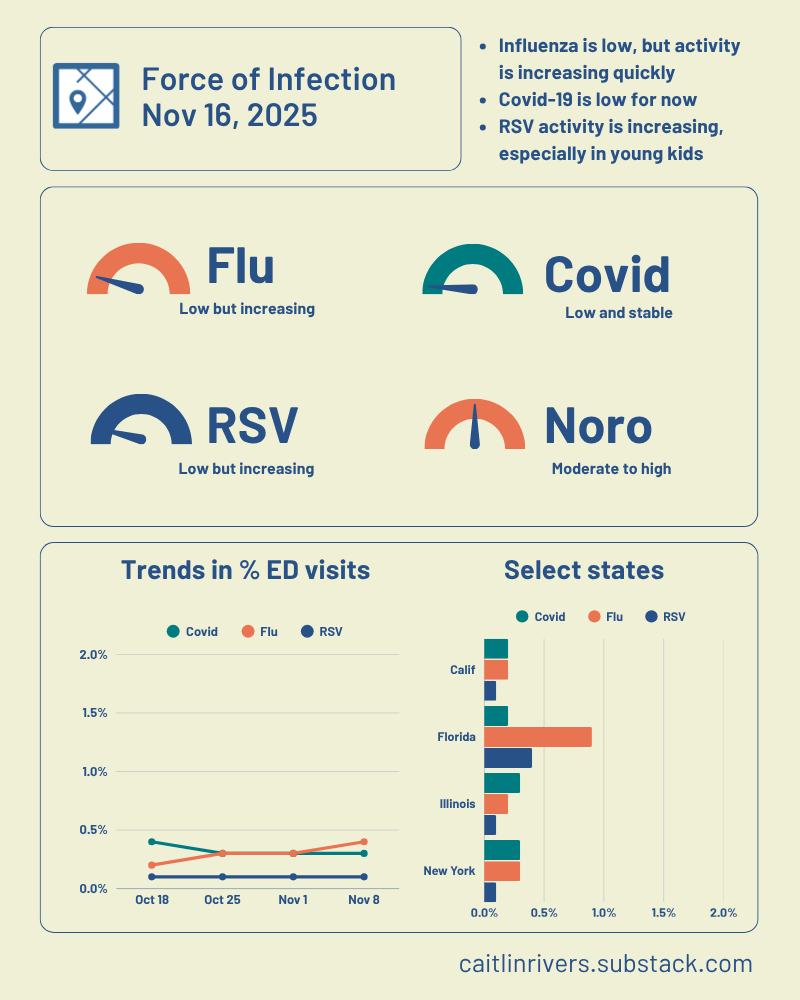
Flu is still low, but activity is rising rapidly. There are a few different signals that suggest this be a rough flu season, despite its slow start in the United States. Other countries have been reporting a particularly early and rough start to their flu seasons, including Japan and the United Kingdom. Their activity is spurred by a new subclade of H3N2 that was first recognized over the summer. H3N2 now accounts for the majority (72%) of subtyped flu infections in the U.S, and subclade K represents about half of those.
H3N2 has in recent years been linked to generally more severe flu seasons. This year’s flu vaccine strain was selected before the new subclade emerged, which means there might be some mismatch between the circulating virus and the vaccine. Nevertheless, the best protection against a bad flu season is to be vaccinated, and encouragingly, preliminary data from the UK suggests that this year’s vaccine is proving to be about as effective at decreasing the risk of hospitalizations for children and adults as in many recent years. However, the UK uses more live attenuated and cell-based flu vaccines than we do in the U.S., so I would not be surprised if they see better vaccine performance.
What is happening right now in the U.S.? The estimated reproductive number is 1.23 nationally, which means that activity is growingly quickly. The CDC’s Center for Forecasting and Outbreak Analytics estimates that flu activity is increasing in all other states for which data are available (39 states total).
While activity is growing rapidly, for the moment, in most states activity remains minimal or low. Outpatient influenza-like illness (ILI) is low but rising, with 2.1% of outpatient visits in the past week due to ILI. As a reminder, outpatient ILI is the percentage of visits to the doctor that are for fever and cough or sore throat. After several weeks of gradual increases, this past week, ILI increased more sharply.
Outpatient ILI visits are rising for all age groups, but have particularly jumped up for those aged 0-4 (to 7.0%), and 5-24 (3.5%). All other age groups are reporting outpatient ILI rates of <1.75%.
Similarly, ED visits for flu are low but have doubled in the past two weeks, to 0.4%. Hospitalizations are also slowly increasing, though they remain quite low at the moment.
What to do: If you haven’t gotten your flu shot yet, get to it right away. And if you are someone who takes extra precautions based on what’s going around, I recommend ramping up soon. While activity is currently low, that’s changing quickly.
COVID-19
Covid-19 activity remains very low. ED visits continue to decline in all four regions, and are at a very low 0.3% nationally. Similarly, hospitalizations continue to fall and are currently lower than they have been in the last year (0.9 hospitalizations per 100,000).
A handful of states in most regions (except the Northeast) have reported some small increases — including New Mexico, Tennessee, and Kansas — but nothing that I am worried about yet.
RSV & Other Bugs
RSV activity is low and rising slowly, particularly in the South. ED visits are picking up for the youngest kids (under 5). Hospitalizations are very low at 0.3 hospitalizations per 100,000 population.
Some new research demonstrates that vaccination against RSV for older adults is highly effective at reducing hospital admissions for RSV. The study looked at adults between 75-79 years old who were admitted to the hospital with acute respiratory infection for more than one day and who received diagnostic essays within 48 hours of admission, and compared those who were positive for RSV with those who were negative, and their vaccination statuses. The RSV vaccine was shown to be 82.3% effective against hospitalization for any RSV-associated acute respiratory infection. These numbers drop slightly for those who had exacerbation of underlying health conditions, such as chronic lung disease or chronic heart disease. Nevertheless, they remain >75%. There is need for additional research to look at how protective the vaccine is in other patient populations — but this research confirms that RSV vaccination for elderly adults is highly effective at decreasing severe outcomes.
Other bugs:
- Several other respiratory bugs that cause cold- and flu-like symptoms are spreading.
- Parainfluenza is climbing its way to its second peak of the year.
- Rhinoviruses/enteroviruses have declined substantially since September, but are still quite elevated and have risen again the past couple weeks.
- Adenovirus peaked a couple weeks ago, and is on a declining trend.
Norovirus
Norovirus test positivity data is back online for the first time in a few months, just in time to tell us that norovirus activity is on the rise.
Nationally, norovirus is up to 11.2% test positivity, from a low of 6.5% over the summer. As a reminder, norovirus causes vomiting, diarrhea, and stomach pain and it spreads extremely efficiently, including in the couple days after symptoms have resolved.
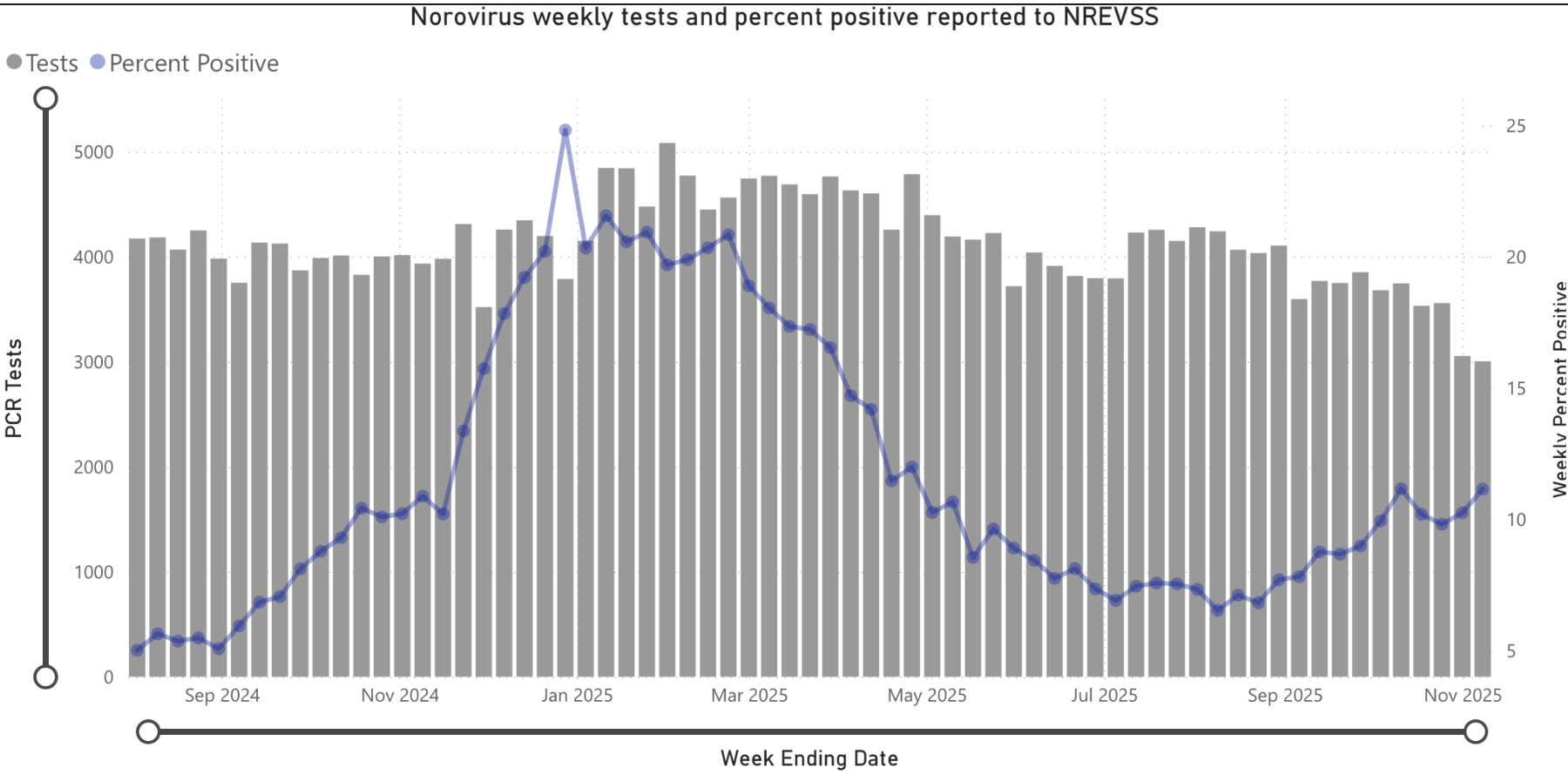
The South has seen explosive growth in the past few weeks, and is now at 17.3% test positivity, and is still rising. It is currently higher than at any point reached in over the past year (and last year was a rough season).
In the West, activity is on a jagged upward path, and after a slight decline over the past month, has increased again to 10.0% test positivity. In the Midwest, after a very rough season, activity levels never quite reached as low as they usually do over the summer months, and have been slowly and steadily rising since late August. As of now, they are at 9.8%. In the Northeast, activity is still fairly low (at 7.6%) but on an overall upward trajectory.
Food recalls
The following foods are being recalled because they are contaminated. Please check your cupboards and throw out any of these items:
The following foods are being recalled because they are contaminated. Please check your cupboards and throw out any of these items:
New:
- ByHeart Infant Formula recall reported last week has expanded to include more batches due to potential botulism contamination (more info).
Previously Reported:
- Peach salsa sold under the Snowfruit label (more info)
- First and Last tomato sauces, distributed in Connecticut and Massachusetts (more info)
- Oven Dried Fish distributed to customers of African Food on Wheels in the Bronx, NY only (more info)
In other news
- Human case of avian influenza H5N5 in Washington state. This is the first known human case of H5N5. Since 2024, according to the CDC, there have been 71 confirmed cases of avian influenza spilling over into humans, all H5N1, which is different. The affected individual in Washington had a backyard flock of domestic poultry that had interaction with wild birds, which is assumed to be the source of exposure, though public health investigations are ongoing. No secondary transmission has been identified.
- A Marburg outbreak has been declared in Ethiopia. Marburg Virus Disease is a viral hemorrhagic fever, which produces severe and often fatal illness. Symptoms include high fever, extreme fatigue, nausea, vomiting, diarrhea, and later in the disease progression, may include bleeding. Nine cases have been identified so far, and contact tracing is in process. There is no approved vaccine or treatment available for Marburg; however, patients who receive early supportive care have a significantly higher chance of survival. Spillovers of Marburg from animals (bats) to humans occur periodically in the region, but no cases had previously been recorded in Ethiopia.
- Canada loses its measles elimination status. Canada has now experienced a sustained measles outbreak for over one year. As a result, the Pan American Health Organization (PAHO) (the regional office of the WHO for the Americas) has notified the country that their measles elimination status, which was achieved in 1998, has been removed. With the removal of this distinction, the entirety of the Americas region has lost its elimination status.
- Lupus cases may be caused by Epstein-Barr virus. New research shows the cellular mechanisms by which Epstein-Barr virus may, in some people, go onto to produce lupus, an autoimmune condition. Most people (over 95%) will contract Epstein-Barr Virus at some point in their lives, and many people will not even experience symptoms with the initial infection. However, mounting evidence suggests that Epstein-Barr virus may have long-term health consequences for some people (including being linked to some forms of cancer). We need quite a bit more research into the link between Epstein-Barr and lupus before we can say with certainty that there is a causal connection, but the new research is an interesting result that underscores how even infectious diseases that appear ‘mild’ can be tied to long-term severe health issues.
- First known fatality linked to meat allergy caused by tick bites. A man in New Jersey died last year of what researchers are identifying as the first known death due to alpha-gal syndrome, which is an allergy to red meat that can be caused by the Lone star tick. Lone star ticks contain a sugar molecular in their saliva (alpha-gal) that is also produced by other mammals, including cows and pigs, but not by humans. Some people who are bitten by lone star ticks will develop an allergy to alpha-gal a few weeks to months later. Then, when they consume red meat, they will experience allergic symptoms (rash/hives, swelling, nausea, vomiting, and diarrhea) 2-6 hours later. This delay in symptom onset is markedly different than for most other food allergies, for which symptoms tend to appear very quickly (within minutes). The CDC estimates that nearly half a million Americans may have alpha-gal syndrome. The best protection against alpha-gal is to avoid tick bites by wearing clothing that protects arms and legs and using insect repellant.
- Regional editions went out earlier today. If you want to receive state-level data but have not subscribed yet, you can access them at https://caitlinrivers.substack.com/newsletters. Future editions will come to your inbox.