

In Texas, flu is now behind 13% of emergency room visits for children ages 5 to 11. In Pennsylvania, the eastern half of the state is seeing more flu than the west. That's the kind of detail in regional editions. Try them free for 7 days, then get any or all four regions for $5 a month or $60 a year. Cancel online anytime.
Influenza-like illness
Although it is only mid-November, we are more than two months into this very early flu season. Activity is still rising in all four regions of the country.
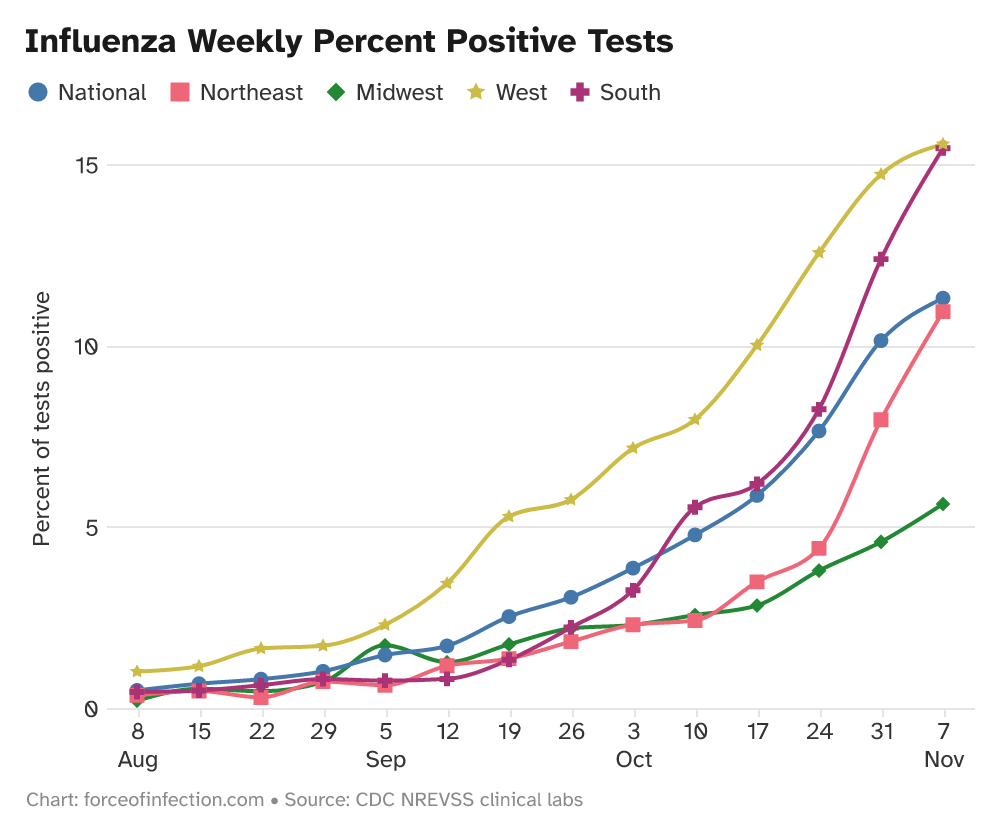
Test positivity continues to climb. At the national level, it rose from 10.1% to 11.3%, compared with less than 2% during the same week last year. The South and West are about tied, both around 15.5%.
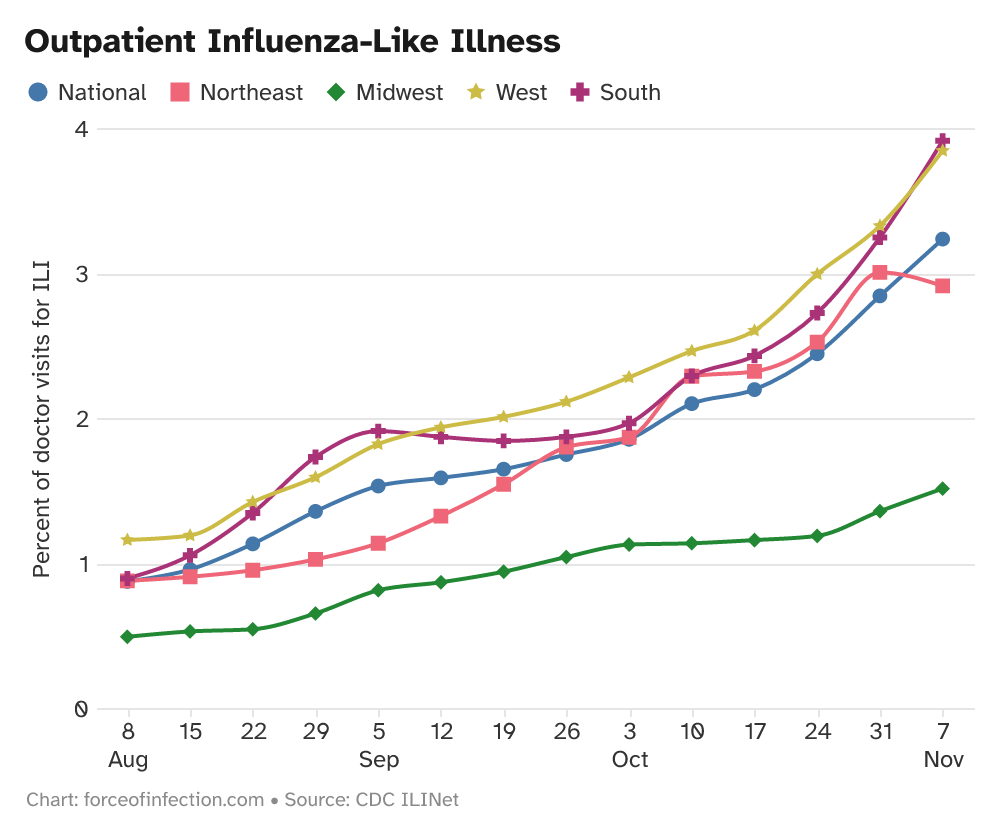
Outpatient influenza-like illness (ILI) increased from 2.8% to 3.2%, the highest for this week since 2022. The South and West are still in the lead, at 3.9% and 3.8%. The Midwest remains the quietest region, at 1.5%, but activity is rising there, too.
Indicators of more severe illness are rising as well. Flu now accounts for 2.2% of emergency department visits, up from 1.7%. During the same week last year it was 0.4%. Hospital admissions rose for the thirteenth week in a row, and adults 75 and older have by far the highest rate.
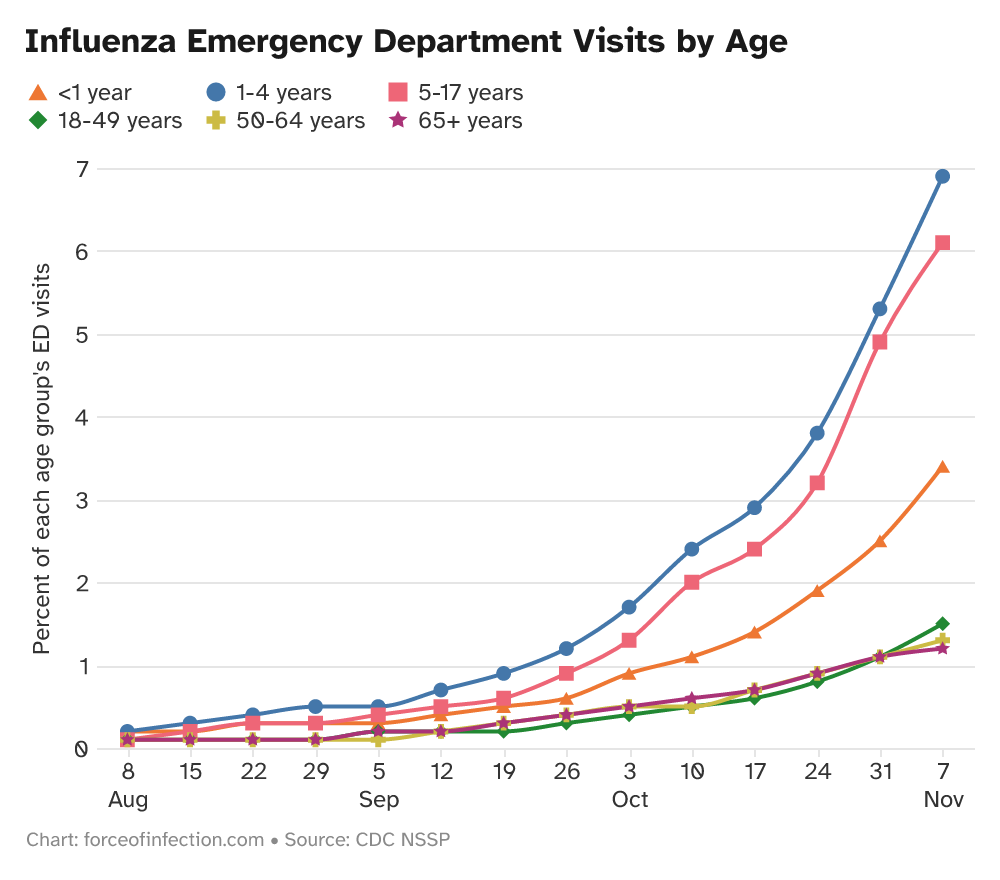
Activity is increasing quickly in young children. Flu accounts for 6.9% of emergency department visits among children ages 1 to 4, up from 5.3%, and 6.1% among school-age children, up from 4.9%. Among adults 65 and older it’s 1.2%. However, do remember that older adults are at the highest risk of hospitalization.
COVID-19
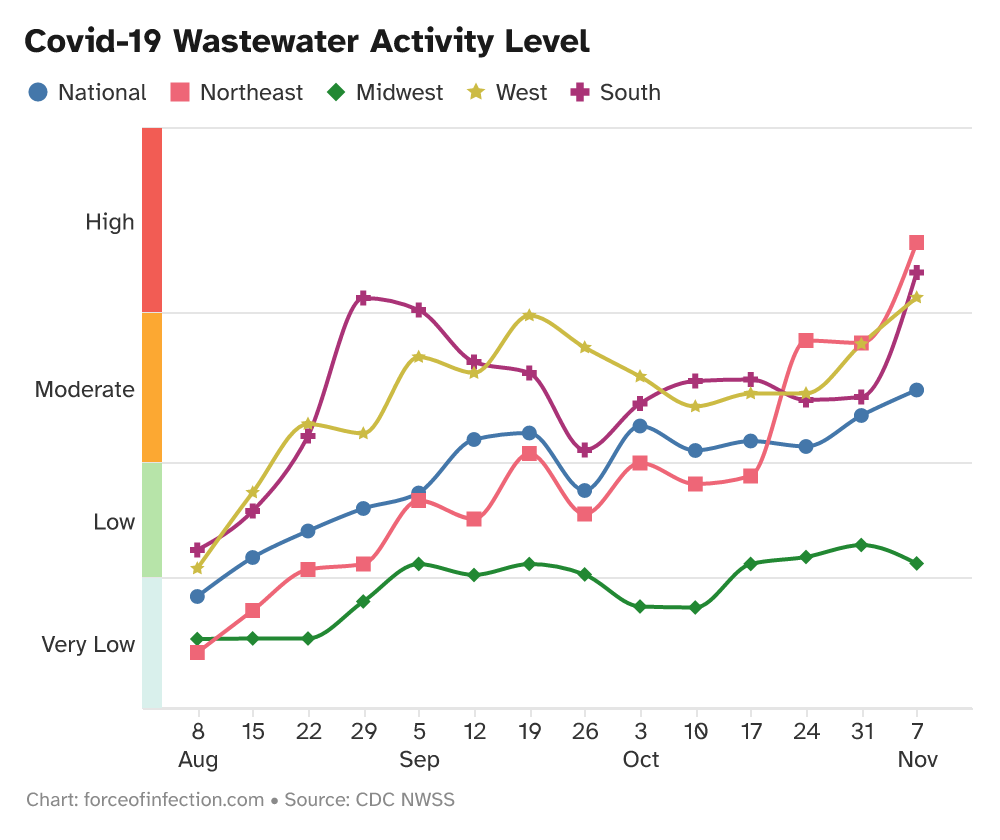
Covid-19 wastewater levels moved from the moderate to high category in the Northeast, South and West this week. However, clinical indicators haven't moved much yet, so I'm still watching and waiting. ED visits are flat at 0.5%, and hospital admissions stayed about the same, at 1.3 per 100,000. The Midwest has the lowest activity.
Adults 75 and older still have by far the highest hospitalization rate, at 8.2 per 100,000, about three times that of adults 65 to 74. Among infants under 1, Covid-19 accounts for 1.6% of ED visits, compared with 1.0% at this point last year.
RSV
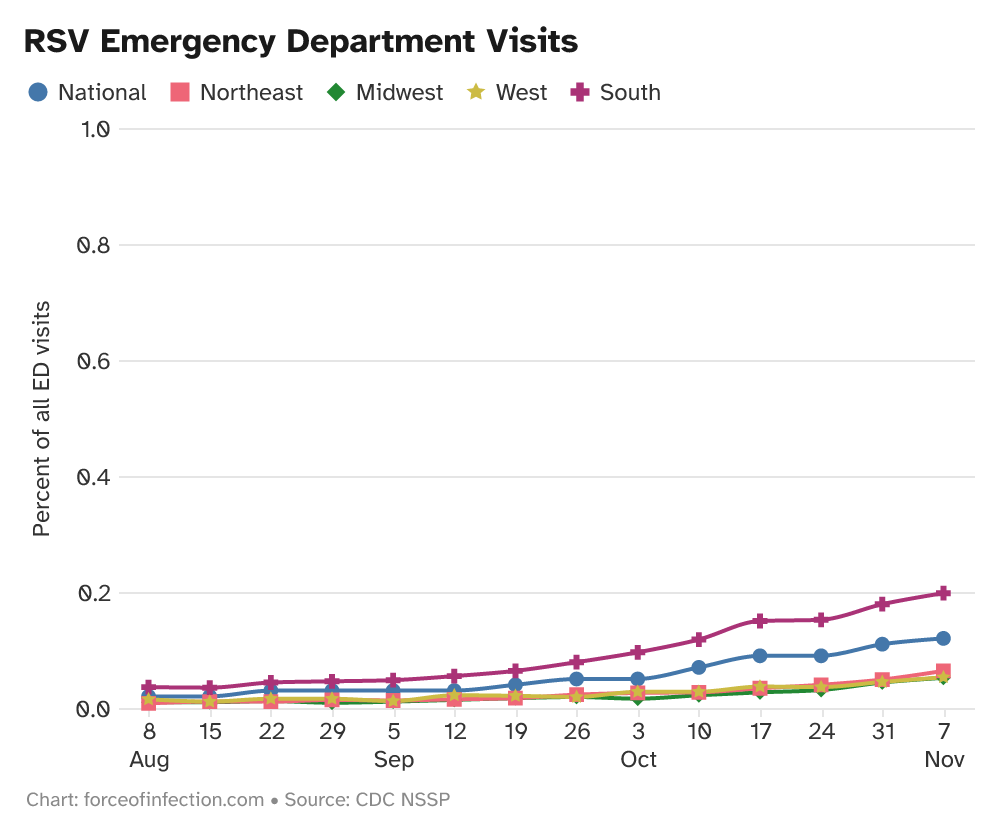
RSV activity is still rising, now accounting for 1.2% of ED visits among both infants under 1 and children ages 1 to 4. Hospital admissions have risen for nine straight weeks and are about level with this time last year. More than half of RSV hospitalizations are in children under 5.
The South is still furthest along, with an under-5 admission rate of 5.7 per 100,000. The Midwest and West are starting to see increases as well. Under-5 admissions roughly doubled in both regions this week, to 2.1 and 1.6 per 100,000.
Food Recalls
New:
- Sausage, Egg & Cheese Biscuit Sandwiches from Fresh & Ready Foods (more info)
- Raw Mild and Sharp Cheddar Cheese from Family Farmstead Dairy (more info)
Previously Reported:
- 365 Whole Foods Market Ashwagandha Capsules from Vitality Works (more info)
In Other News
- The United States has lost its measles elimination status, according to several news reports. The Pan American Health Organization (PAHO) met this week and determined that measles has re-established regular transmission in the country, KFF Health News reported on November 14, citing researchers with direct knowledge of the deliberations. PAHO has not announced the decision publicly yet. The United States had held elimination status since 2000. The decision was expected. Canada lost its status last year, and Mexico was under review at the same meeting. CDC has reported 5,412 cases this year as of November 12, the most since 1991.
- About half of adults who still have long Covid a year after infection improve meaningfully in the following years, according to a new study in Annals of Internal Medicine (paywalled). Researchers followed 1,019 adults at 83 US sites who met a symptom-based threshold for likely long Covid 12 months after their first infection. By three years after infection, about half had dropped below that threshold, and 27% had none of the symptoms being studied. Recovery was much less likely for people with symptoms across multiple body systems, compared with those whose main symptom was a change in smell or taste. People infected during the Omicron era and adults under 46 were somewhat more likely to improve. The authors say the results underscore the urgent need for treatment trials.
Have questions or comments? Reach us at support@forceofinfection.com.