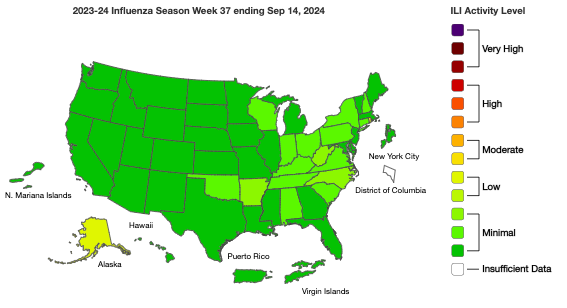
Influenza-like illness
All clear. Influenza remains minimal nationally. Wastewater activity is minimal, and only 1.9% of outpatient visits were for influenza-like illness.
A note on cold-causing viruses: A few weeks ago, I noted that we were seeing an increase in test positivity for rhinovirus/non-polio enterovirus. Often these viruses are one cause of the common cold, though sometimes they can cause more severe illness in children or people with weakened immune systems. These rates have continued to rise in recent weeks. We are now up to about 30% test positivity, compared to about 16% a month ago.
Covid-19
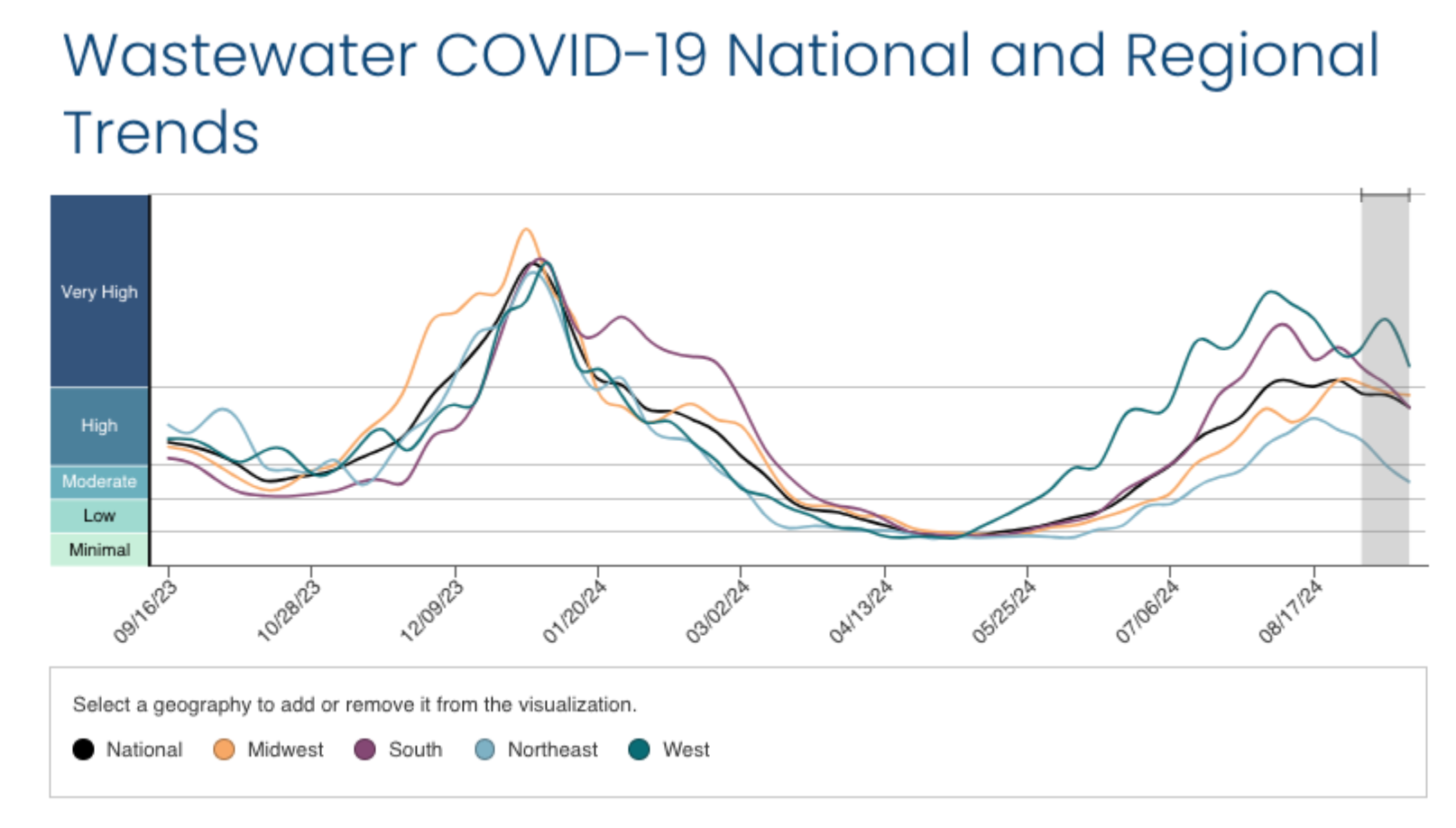
The late-summer wave appears to be receding in most of the country. Wastewater activity remains high, but it dipped slightly in all four regions, after several weeks of stagnation.
The Western region still has the highest wastewater concentration, followed closely by the Midwest and South. Activity in the West is more than double that in the Northeast.
Severe illness is declining as well. Visits to the ED declined moderately this past week, to 1.7% of all ED visits. Hospitalizations declined for the fifth week in a row, to 2.8 per 100,000 people.
Western region
Things are improving across much of the West. Wastewater activity is still very high, but appears to be dropping. Most states reported moderate or substantial decreases in ED visits. Every state that reports hospitalization data reported a decrease this past week.
Wastewater activity is low in Hawaii and the rate of ED visits is 1/3 of the peak it reached in June. Wastewater activity is minimal in Nevada, and moderate in Alaska and Arizona, and ED visits are dropping in all three states.
Although activity remains very high in Colorado, ED visits are down, and hospitalizations dropped by roughly 2 points this past week (to 1.9 per 100,000).
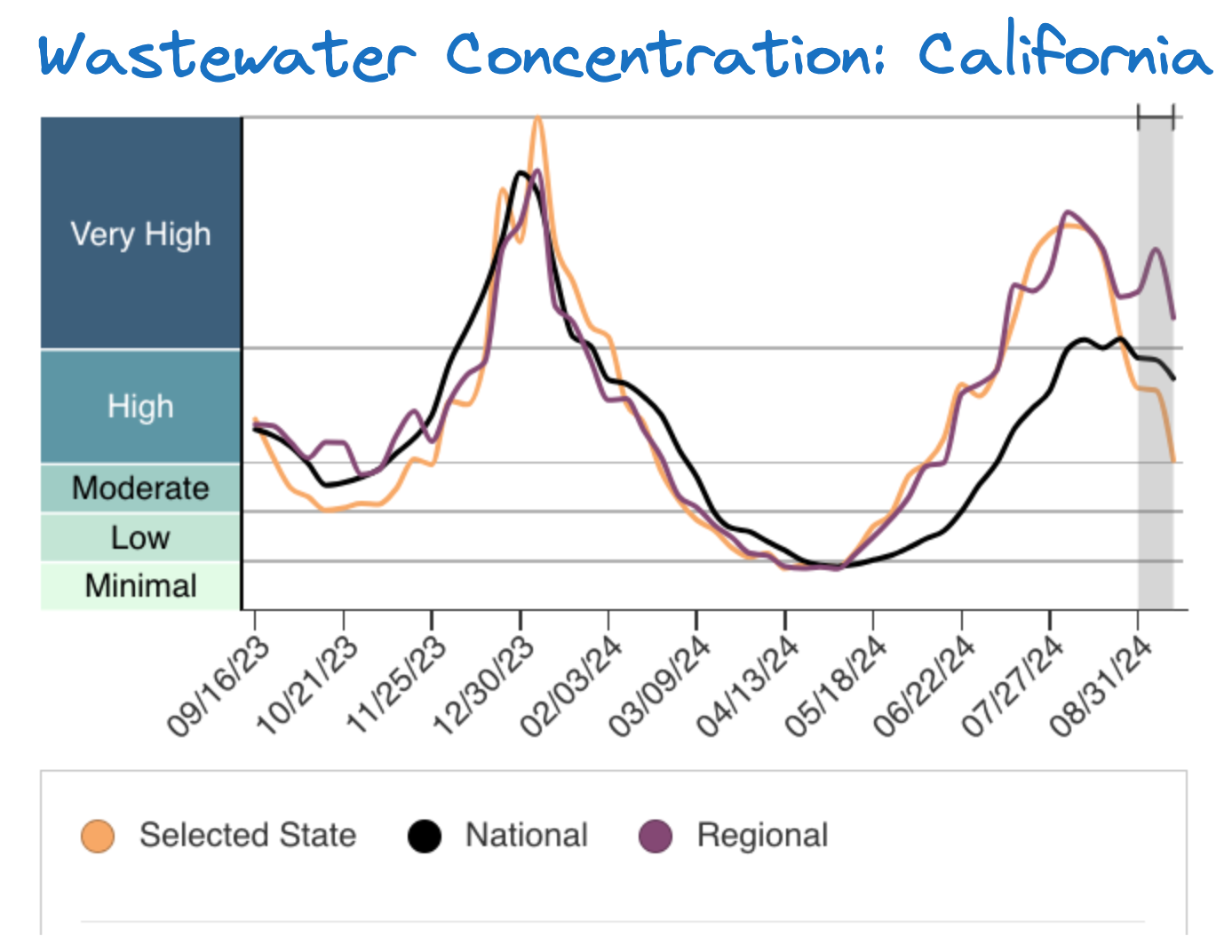
Similarly, wastewater activity remains high in New Mexico and California, but is on a downward trend, as are ED visits. In New Mexico, hospitalizations are now back down to where they were before the summer wave. In California, the rates for ED visits and hospitalizations have both declined by half since August.
Wastewater activity remains very high in Washington, Oregon, Utah, and Wyoming. Nevertheless, ED visits declined in all of these states this past week, and hospitalizations declined in both Oregon and Utah.
However, the situation is not quite improving yet in a couple states: in Idaho and Montana, wastewater activity is very high and ED rates were stable this past week.
Southern region
The summer wave has clearly peaked: wastewater activity has declined from “very high” to “high” and ED visits declined moderately or substantially in every state in the region.
Nevertheless, wastewater activity remains high in Texas, Louisiana, Florida, Alabama, Kentucky, West Virginia, Delaware, Maryland and very high in North and South Carolina, Arkansas, and Oklahoma.
The only state reporting low wastewater activity in the region is Virginia. Several states have limited wastewater activity coverage (Tennessee, Mississippi, and Georgia).
Hospitalizations declined 2 points in Georgia, back down to low levels (1.6). Similarly, the hospitalization rate declined in Maryland back down to where it was before the summer wave. Hospitalizations held steady in Tennessee (2.6), though the rate has declined considerably since peaking at 5.0 in August.
Northeastern region
Wastewater activity is moderate and declining, and substantially lower than the national average. ED visits declined or held steady across the region. However, hospitalizations increased in Connecticut and New York.
Although wastewater activity is minimal and ED visits held steady in New York, the hospitalization rate increased again to 8.5, which is higher than it has been at any point since January.
Wastewater activity is very high and increasing in Rhode Island, Vermont, and high and increasing in New Jersey and Connecticut. Wastewater activity is very high, but decreasing in Maine, New Hampshire, and Massachusetts.
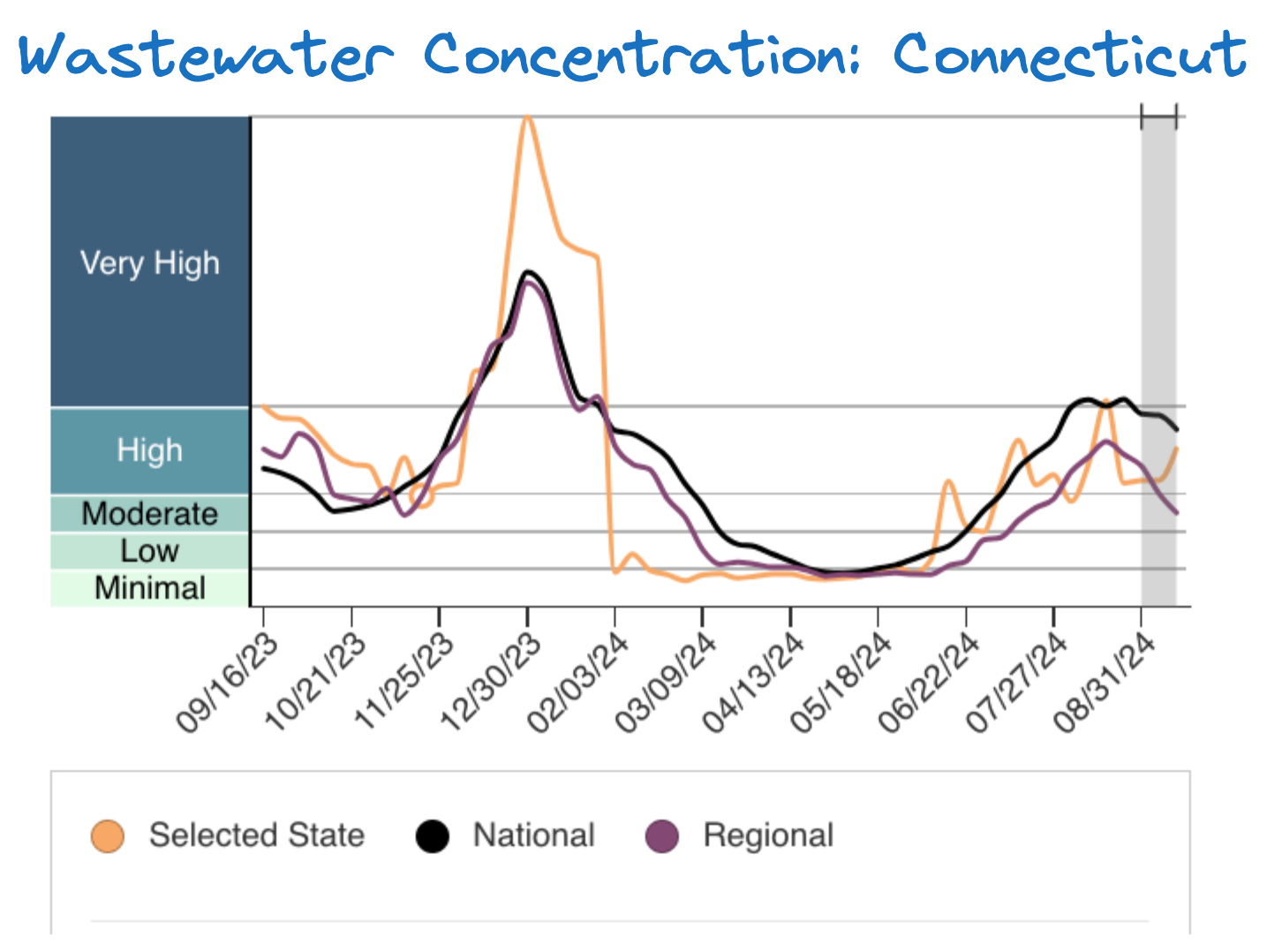
ED visits held steady in Connecticut, Pennsylvania, Massachusetts, Vermont. ED visits declined substantially in Maine and Rhode Island, and moderately in New Jersey and New Hampshire.
Midwestern region
Wastewater activity remains high, though it dipped slightly this past week. ED visits held steady or declined in every state in the region.
Wastewater activity is high in Illinois, Indiana, Kansas, Nebraska, Missouri, and Iowa, but all of these states reported moderate or substantial declines in ED visits (with the exception of Missouri, for which no data are available). Similarly, despite very high wastewater activity, both Minnesota and Ohio reported declines in hospitalizations.
Despite low wastewater activity in Michigan, both ED visits and hospitalizations in the state have been on an upward trend for the past few months. However, ED visits remained stable this past week, and hospitalizations dipped slightly (to 4.7).
Wisconsin continues to be stable, but not in a good way: wastewater activity has been stable at very high levels in the state for the past month and a half. This past week, ED visits also held steady at an elevated rate.
Stomach Bugs
Norovirus test positivity is up to 7.5%, an increase of 2 points in 2 weeks. Overall testing has declined by about 1/3 in the past three weeks, so this may not represent a true increase. Wastewater concentration has remained stable since August.
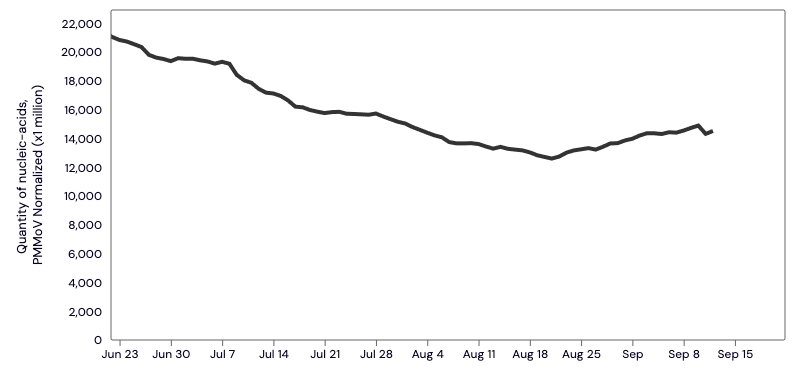
If this is a true increase, we are a bit higher than typical for this time of year, but we remain below the levels we see in peak norovirus season. While norovirus spreads throughout the year, norovirus rates tend to be highest from November-April, often peaking around January. This means that, even though we just got out of a really extended season, it may already be ramping up again.
Food recalls
New:
- None
Previously reported:
- Whole Cantaloupe (more info)
- Eggs under labels “Milo’s Poultry Farms” and “Tony’s Fresh Market” (more info)
- Don’t forget to throw out Boar’s Head deli meats (more info)
In Other News
My debut book, Crisis Averted, is being published on October 8, just two weeks away! It’s a look at the hidden science of fighting outbreaks. The book features plenty of suspenseful stories of high-stakes outbreaks, and the people who combat them. You can pre-order Crisis Averted wherever books are sold (click here for options!). If you’re still on the fence, consider Kirkus Reviews’ take:
[Rivers] is optimistic about the capacity of the system to respond, with national and international agencies providing important avenues for cooperation. The author clearly knows everything there is to know about her subject, and she writes with clarity, insight, and authority. An informative, accessible package, useful as an examination of the road behind and the path ahead.
I found this research report fascinating, showing that 75% of U.S. adults support wastewater monitoring for infectious diseases, and 95% would adopt protective health behaviors, such as handwashing or avoiding large gatherings, if wastewater data indicated disease transmission. The survey finds broad public support for rapid access to this data, even when risk interpretations are unclear.
The Los Angeles County Department of Public Health is investigating two additional cases of locally acquired dengue in Baldwin Park, bringing the 2024 total to three. These cases are an unprecedented occurrence in the state. Officials urge residents to eliminate standing water, use insect repellent, and secure window and door screens. Public health efforts include door-to-door outreach and increased mosquito control in affected areas. Dengue symptoms include fever, headache, joint pain, and rash.
CBS News reported on a rapid rise in whooping cough (pertussis) cases, with 291 cases for the week ending Sept. 14, marking the fastest increase in nearly a decade. Over 14,500 cases have been reported in 2024, over four times higher than last year. States like New York, Ohio, Pennsylvania, and Oklahoma are seeing significant spikes, particularly among teens. Factors include waning vaccine effectiveness and potential bacterial mutations. The FDA is considering human trials to develop more effective vaccines, as current boosters result in declining immunity over time.
A second healthcare worker in Missouri who cared for a patient with H5N1 bird flu developed mild respiratory symptoms but was not tested for influenza, the CDC reported. Despite this, the CDC maintains that public risk remains low. There is now 1 confirmed case and 3 possible cases under investigation in this potential cluster. Blood samples from the initial patient and close contacts are being tested for antibodies to confirm past infections. Missouri’s investigation continues, but the CDC has not been invited to assist. I find this unsettling, of course, but there are lots of infections that cause flu-like illness, so we will have to wait for the serology results to assess the risk.