

Force of Infection will switch to the winter publication schedule on October 18. The national edition will be free for all subscribers. Paid subscribers can elect to receive regional editions, with detailed information about every state. Click here to learn more about regional editions.
Influenza-like illness
Influenza activity continues to exceed what we typically see this time of year, specifically in the West. However, I now see signs that the South is also in play.
Most striking is test positivity for influenza. HHS Region 9, which includes Arizona, California, Hawaii, Nevada and the Pacific territories, is at 9.5%, up from around 7% the week prior and around 2% in late August. Nearly all of that is influenza A. For context, this region peaked at around 15% last winter, so we are already well on our way.
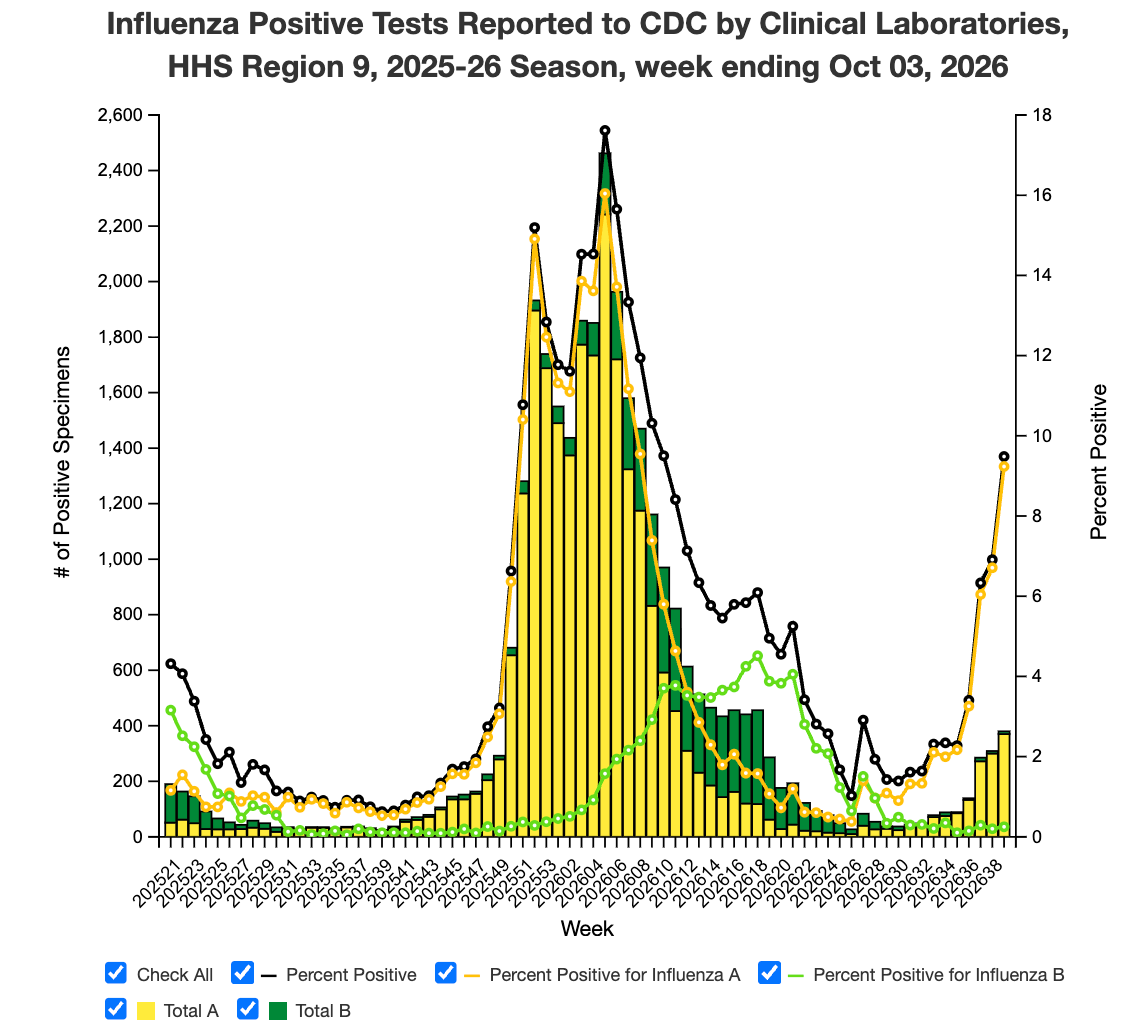
Region 10, which includes Alaska, Idaho, Oregon and Washington, is also elevated at around 5%. That is down from between 6.5% the week prior, which is an interesting (and possibly spurious?) divergence from its Region 9 neighbor. I am also watching Region 4, which covers Alabama, Florida, Georgia, Kentucky, Mississippi, North Carolina, South Carolina and Tennessee. Test positivity there is still low at around 3%, but it more than doubled in a week. This is one of the signs that the South is now in play.
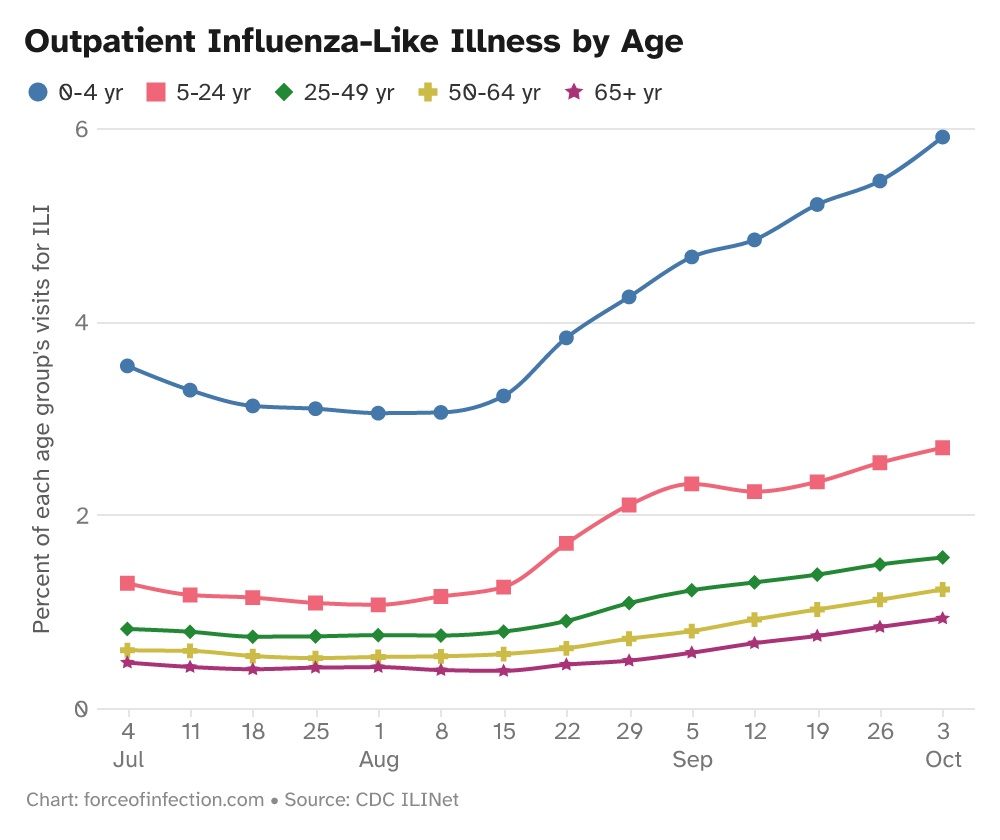
At a national level, outpatient influenza-like illness (ILI), which is the percentage of visits to the doctor that are for fever and cough or sore throat, increased from 1.7% to 1.8%. As usual, children ages 0-4 have the highest levels of outpatient ILI at 5.9%, up from 5.5% the week prior. Activity in people ages 5-24 is also rising, now at 2.7%. Older age groups are at 1.6% and below.
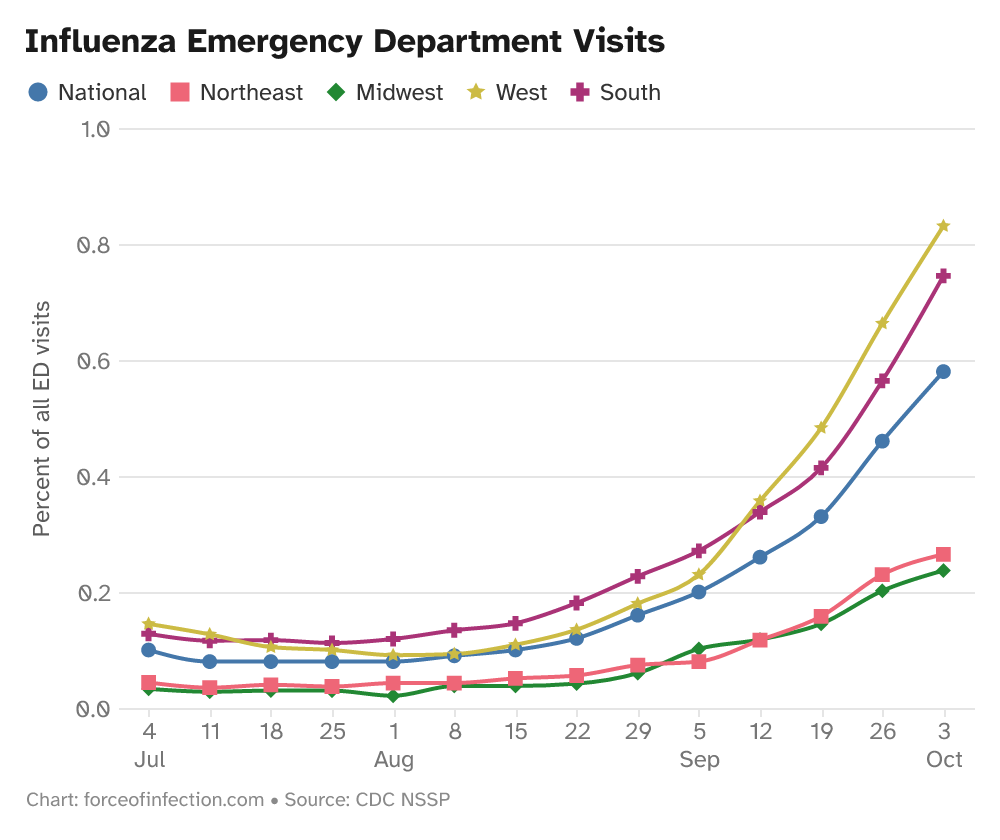
Emergency department visits for influenza are at 0.6%, a level last season did not reach until mid-November. Much of that is contributed by the Western region where ED visits are 0.8%. I want to call out Hawaii specifically, where emergency department visits for influenza are especially high at 4.8%. The South is also elevated at 0.7%. In contrast, activity in the Northeast and Midwest is low at 0.3% and 0.2%, respectively.
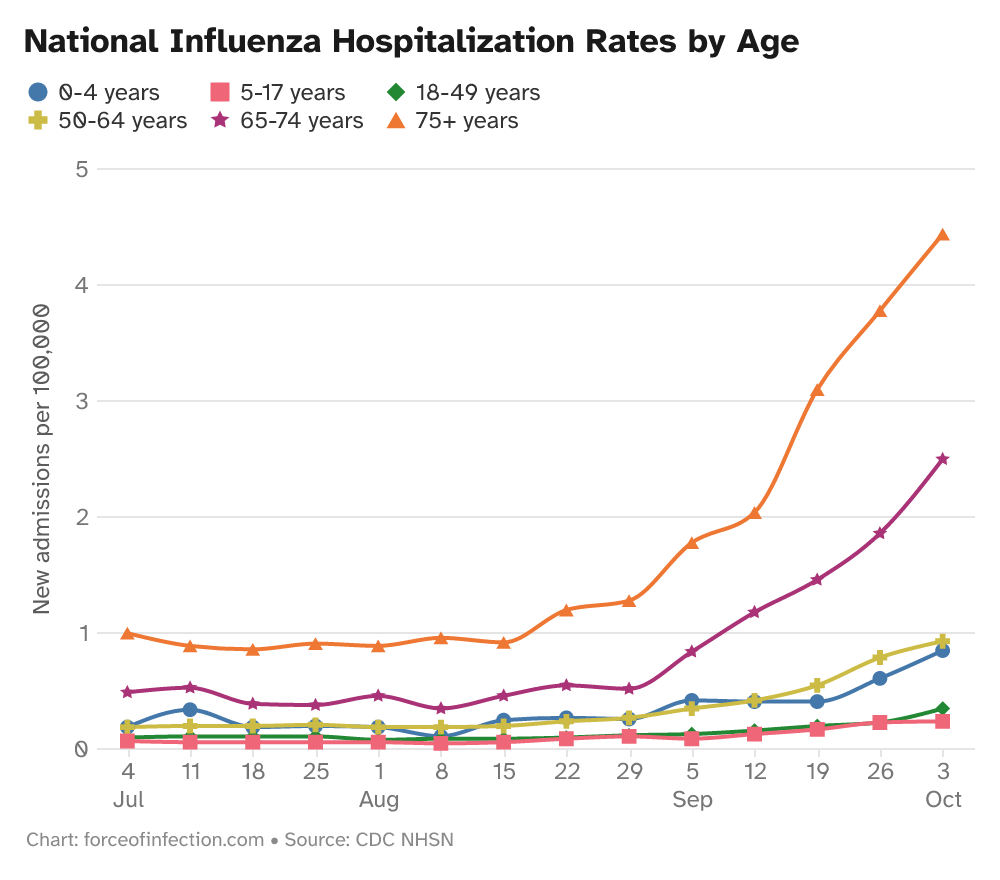
The Western and Southern regions also have elevated hospitalizations at 1.2 per 100,000 and 1.1 per 100,000, respectively. Last year at this point, hospitalizations were at 0.2 and 0.4 per 100,000. This is about seven to nine weeks ahead of last year’s timing.
Looking now at impacts by age, people ages 75 and older have the highest rates of hospitalization for influenza, now at 4.4 per 100,000 up from 3.8 the week prior. People ages 65-74 are also disproportionately impacted at 2.5 per 100,000.
COVID-19
The summer Covid-19 season is receding, and we can now say that it was modest. Emergency department visits for Covid-19 peaked in early September at under half of last summer’s peak (0.6% compared to 1.7%). Current ED visits are 0.5%, with the West and South most affected at 0.6% for both.