
School year starts with sick days
During summer months, this weekly respiratory illness report is available to paid subscribers. Beginning in October with the onset of flu season, everyone receives the national overview for free, while paid subscribers receive bonus regional reports with state-by-state details to help you understand what's happening locally.
Respiratory Diseases
Influenza-like illness
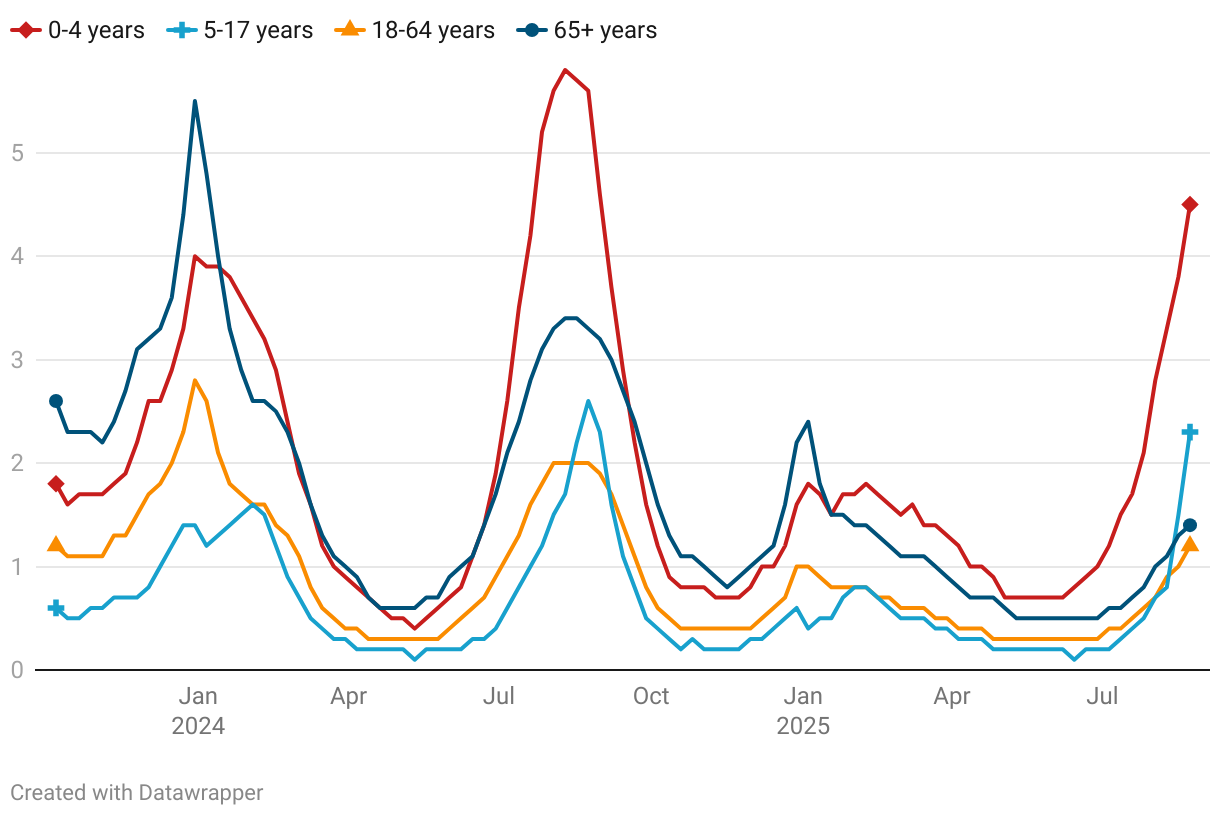
Influenza-like illness remains low, as expected for late summer. Just 1.4% of visits to the doctor were for fever and cough or sore throat.
One thing I found interesting: there are signs of increasing influenza activity, especially in the South. It’s pretty early for flu season to start, so I’ll be watching closely. But to be clear, what I’m seeing are tiny signals that could easily evaporate. Current levels of flu activity are still very low.
Influenza vaccines are now available in many places, but unless you have a compelling reason like upcoming travel, I recommend waiting until October to get vaccinated. If early seasonal activity does pick up enough to change this outlook, I will be sure to let you know.
Young children continue to experience the most flu-like illness, with 4.4% of their doctor visits related to these symptoms. This age group has shown five consecutive weeks of increases, though the overall levels are still relatively low. Similarly, in the 5 to 24-year-old age group, activity has risen slightly from 1.3% to 2.3% in recent weeks. Increases will likely continue now that the school year has resumed.
Reminder: I am accepting applications for my Voices in Print project, which pairs science writers with patients who have a specific insight about how care for their conditions should be improved. The goal is to create editorials for medical journals.
 Caitlin Rivers
COVID-19
In my opinion, the two hardest calls to make are season onset (when a wave is beginning) and peak week (when activity is cresting). Trends are always clearest after a few consecutive weeks, but by then the moment has passed. My goal is to make these calls both accurately and as close to real time as possible. It doesn’t always work out. Last flu season surprised us with two separate peaks, which is a reminder that it's not over until it's truly over.
With those caveats all out of the way: I expect activity has peaked in the West, while the South is probably a week or two away from its peak. The Midwest and Northeast also look like they are at or near peak, but with much lower levels of activity.
Around 1.5% of visits to the emergency department are for Covid-19 nationwide, the highest it's been since September of last year. This is a significant increase from our recent low of 0.3% but remains modest compared to all-time peak (e.g. over 3% in December of 2023). The South and West continue to be most affected.