Covid peaking while flu-like illness stirs
During summer months, this weekly respiratory illness report is available to paid subscribers. Beginning in October with the onset of flu season, everyone receives the national overview for free, while paid subscribers receive bonus regional reports with state-by-state details to help you understand what's happening locally.
Respiratory Diseases
Influenza-like illness
Influenza-like illness (ILI) is making some moves. Although activity remains low, it has increased for four consecutive weeks. Outpatient ILI, or the proportion of visits to the doctor that were for fever and cough or sore throat, rose from 1.4% to 1.8%. For reference, the threshold that marks the start of flu season is 3%.
This early uptick doesn't necessarily mean we're headed straight for an early season, but it bears watching closely. As a point of comparison, the 2022-23 season followed a similar trajectory, but we did not cross the 3% threshold until late October.
As usual, children are experiencing more influenza-like illness than older age groups. Over the last two weeks, ILI activity in kids ages 0-4 jumped from 3.6% to 5.0%. Activity in school-aged children 5 to 24 rose from 1.7% to 2.8%. Older age groups are all below 1.5%. This pattern is reflected in emergency department visits as well, where children ages 0-17 have slightly higher rates than older adults (but low overall).
The increases in activity are concentrated in the Southern region, where outpatient ILI is now 2.3%. As with Covid-19, influenza activity often begins in the South.
COVID-19
I am now more confident that Covid-19 has peaked in the South and West.
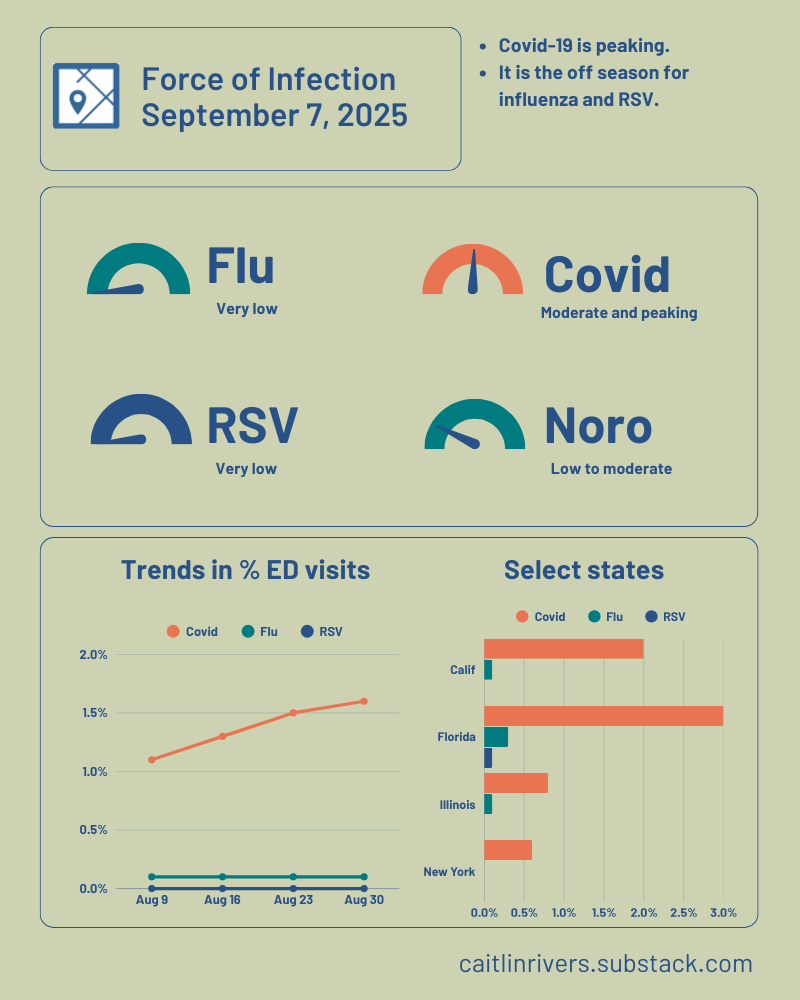
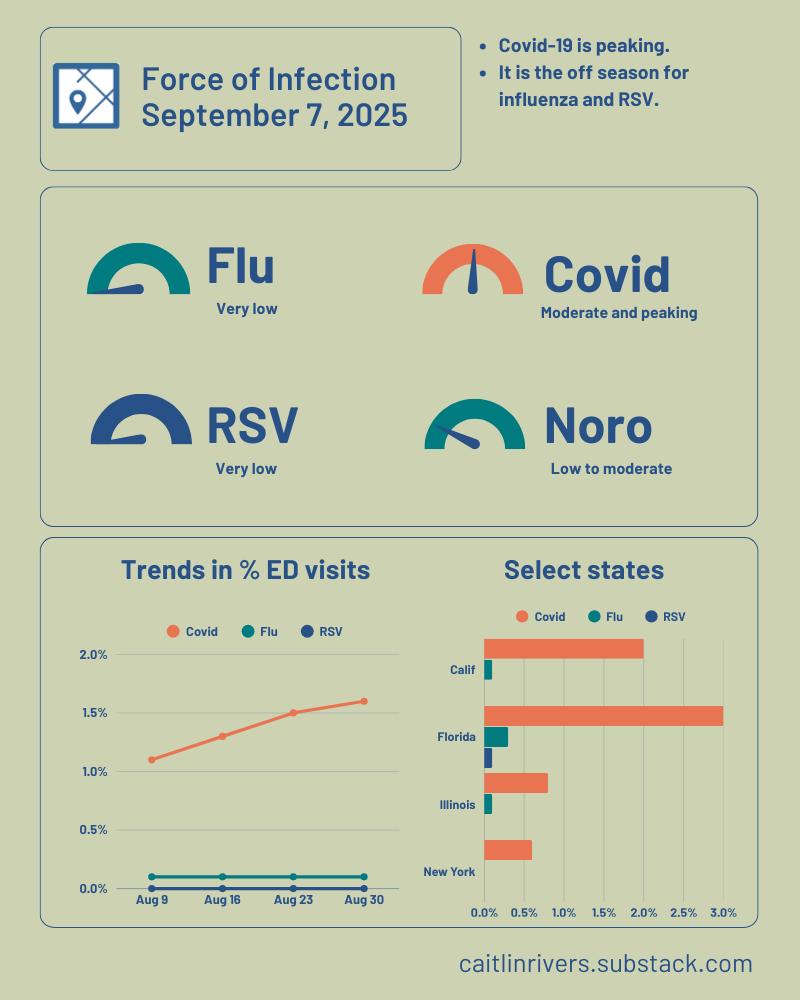
Activity is moderate nationally and still rising, though not at the same clip as we have seen over the past several weeks.
The West and South continue to have activity ~1.5-2x that of the Northeast and Midwest.
Covid-19 now accounts for 1.5% of trips to the emergency department nationally—higher than the off season, but low compared to an intense season. Hospitalizations are also up from recent lows, but still fairly low at 2.9 hospitalizations per 100,000.
West
Activity is high, but appears to be past its peak for the region. Nevertheless, all states in the region are reporting moderate or higher wastewater activity.
Utah, Hawaii, and Alaska, appear to have passed their peaks. Wastewater activity and hospitalizations are on the decline in all three states, and ED visits are also down in Hawaii. In Washington, wastewater activity also suggests that the peak is past, but other indicators have yet to follow.
Activity is still rising in several states, however. This includes Idaho, which has the highest activity in the region, as well as California and Nevada, which also have very high and increasing wastewater activity. Trips to the ED are also increasing in all three states. Similarly, in Oregon and Wyoming, wastewater activity is high and increasing, and ED visits are also on the rise.
Midwest
Activity is fairly low across the Midwest, though it is increasing. In all but one state in the region, wastewater activity remains moderate or lower.
The exception is Indiana, where wastewater activity is very high and rising. ED visits have also picked up a touch in the state, though hospitalizations remain low.
Northeast
Activity is moderate and increasing across the region. Wastewater activity is moderate but on an upward swing in Maine, New Hampshire, and Rhode Island. Rhode Island also shows an increase in hospitalizations.
The highest activity is in Connecticut, where wastewater activity is very high and climbing. However, hospitalizations remain fairly low (at 2.0 per 100,000). In New York, Pennsylvania, and New Jersey, activity remains low.
South
The South is currently the hardest hit region, with high wastewater activity.
Louisiana has the highest wastewater activity in the region, along with moderately elevated ED visits and hospitalizations. Activity looks to be near peak in Texas, with very high wastewater activity, and elevated ED visits.
In Florida, wastewater activity is very high and severe illness is elevated. Emergency room visits are at 3%, and the hospitalization rate is up to 5.6 per 100,000. Activity is similarly very high and rising in Alabama, Washington, D.C., and North Carolina. All three states also have elevated ED visits.
Wastewater activity remains a bit lower — at high levels — but is still increasing in Arkansas and Kentucky. In Virginia and South Carolina, activity appears to be past peak but remains elevated.
RSV & Other Bugs
RSV remains very low, but I do see the beginnings of some activity. Visits to the emergency department, for example, have increased from zero to slightly more than zero in the South. Something I will watch in the weeks ahead.
Other Bugs: Sniffle time — rhinoviruses/enteroviruses are way up and parainfluenza is moderately elevated. Sore throats are also on the rise.
Norovirus
Norovirus data from the CDC still has not been updated — the most recent data available is from the week ending August 9. However, my two backup data sources show low but rising activity.
Food recalls
The following foods are being recalled because they are contaminated. Please check your cupboards and throw out any of these items:
New:
- Endico frozen peas and carrots, and mixed vegetables (more info)
Previously reported:
- Various cocktail shrimp, including those sold under brand names Kroger, Great Value and Aqua Star (more info) and frozen and cooked shrimp under multiple brand names (Sand Bar, Arctic Shores, Best Yet, Great American, First Street) due to possible Cesium-137 (radionuclide) contamination (more info)
- Country Eggs, large brown sunshine yolks (more info)
- Viva ground beef for dogs and ground chicken for dogs and cats (more info)
- Pepper Jack cheese and Horseradish-flavored cheese sold under Middlefield, Copia Collective, and Farmers Cheese labels (more info)
- Brie Royal Faucon cheese (more info)
- “Spanish cheese” sold by Quesito El Establo (more info)
- Multiple cheese products sold at Wegmans that include Medium Camembert Soft Ripened Cheese (more info)
- If you have food allergies, you may wish to review these FDA safety alerts and USDA alerts for foods with undeclared allergens.
In other news
- Salmonella outbreak in eggs has sickened at least 95 people in 14 states. The eggs have been traced to Country Eggs and have been recalled (see above recall). Most of the known cases of illness have been reported in California, and 18 people linked to the outbreak have been hospitalized. Because most people who get food poisoning do not go to the doctor, and few of those people are tested for the cause of their illness, this is likely a vast undercount of the number of people who have been sickened by this outbreak. While most people who get food poisoning recover at home with fluids and rest, be wary of any signs of dehydration. Seek medical attention if you are dehydrated, have vomiting or diarrhea for more than two days, a high fever (over 102 degrees for adults), or bloody diarrhea or urine.
- H5N1 highly pathogenic avian influenza infection in a cat has been linked to raw cat food. Specific batches of RAWR Raw Cat Food Chicken Eats were found to contain the virus, and the same strain was isolated from a cat who became ill in California. This poses a significant health risk to cats, and potentially to humans as well. No human infections have been linked to this product, but cross-contamination could pose an issue.
- Florida will remove all state vaccine requirements, including those for schoolchildren. Currently, the state requires children in daycare facilities and public schools to be vaccinated against polio, hepatitis B, measles, and tetanus, among other diseases. There is no scientific or public health rationale for removing these requirements, and lifting them poses a significant risk to public health in the state. The Florida Surgeon General, Dr. Joseph Ladapo compared vaccine requirements to “slavery” in his announcement of the changes.
- Contentious Congressional hearing. Secretary of Health and Human Services Robert F. Kennedy Jr. faced intense criticism during a contentious Senate Finance Committee hearing. Senators from both parties pressed Kennedy on his anti-vaccine efforts, including his firing of all CDC vaccine advisers and replacement with vaccine critics, restrictions on vaccine access, and cancellation of $500 million in mRNA research. Kennedy remained combative and dismissive throughout the hearing, getting into shouting matches with senators and suggesting further reorganization of the CDC.