

Force of Infection is now on the summer schedule, meaning national Outbreak Outlook updates are only available to paid subscribers. The winter schedule, including the free national version, will resume in October. To continue receiving reports during the summer, please upgrade to paid.
Influenza-like illness
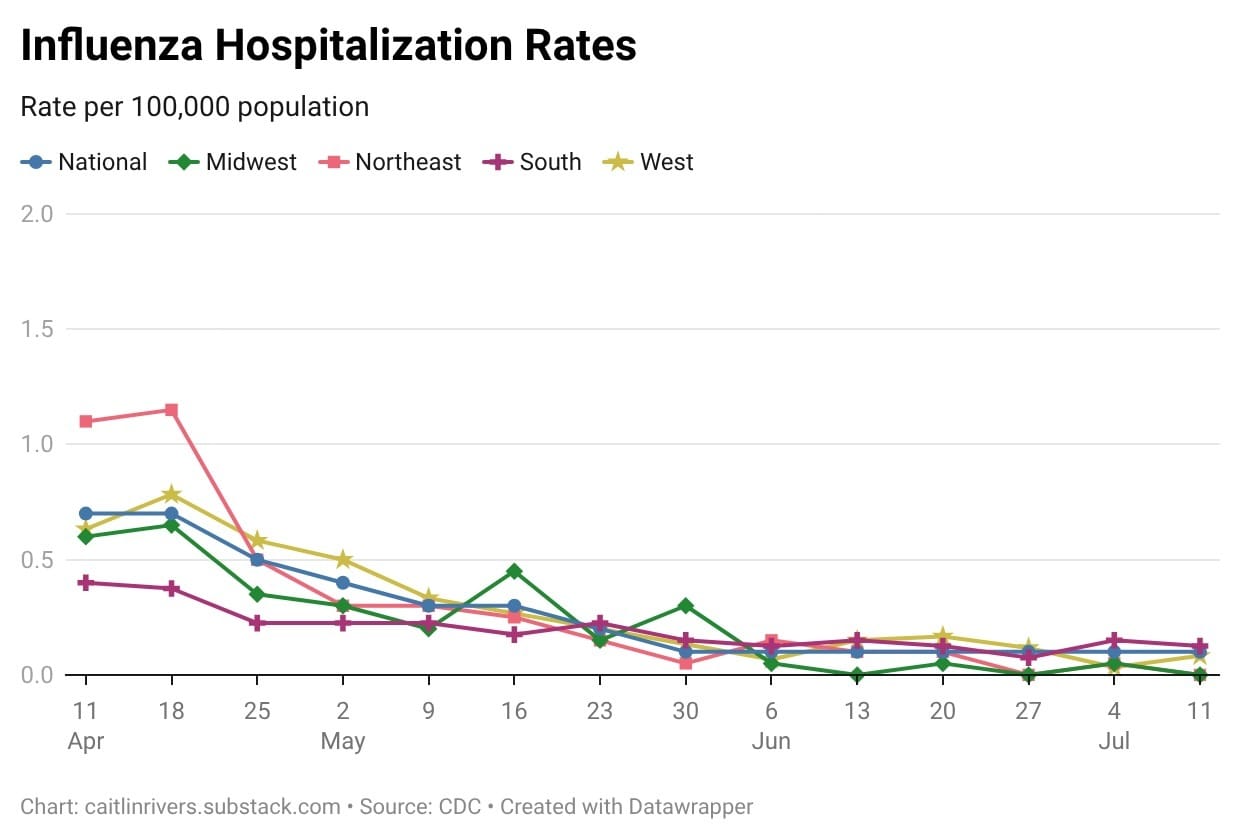
Seasonal influenza remains low at this time of the year. The percentage of visits to the doctor for symptoms like fever, cough and sore throat (referred to as ILI) is steady at 1%, which is very low.
The West sits slightly above the national average at 1.2%, while the Midwest registers the lowest ILI at 0.5%. This week, the South is slightly lower than last week and continues to trend down, below 1%.
Severe illness remains low. Visits to the emergency department (ED) are holding steady at 0.1%. All regions remain steady. The weekly influenza hospitalization rate is very low at 0.1 per 100,000.
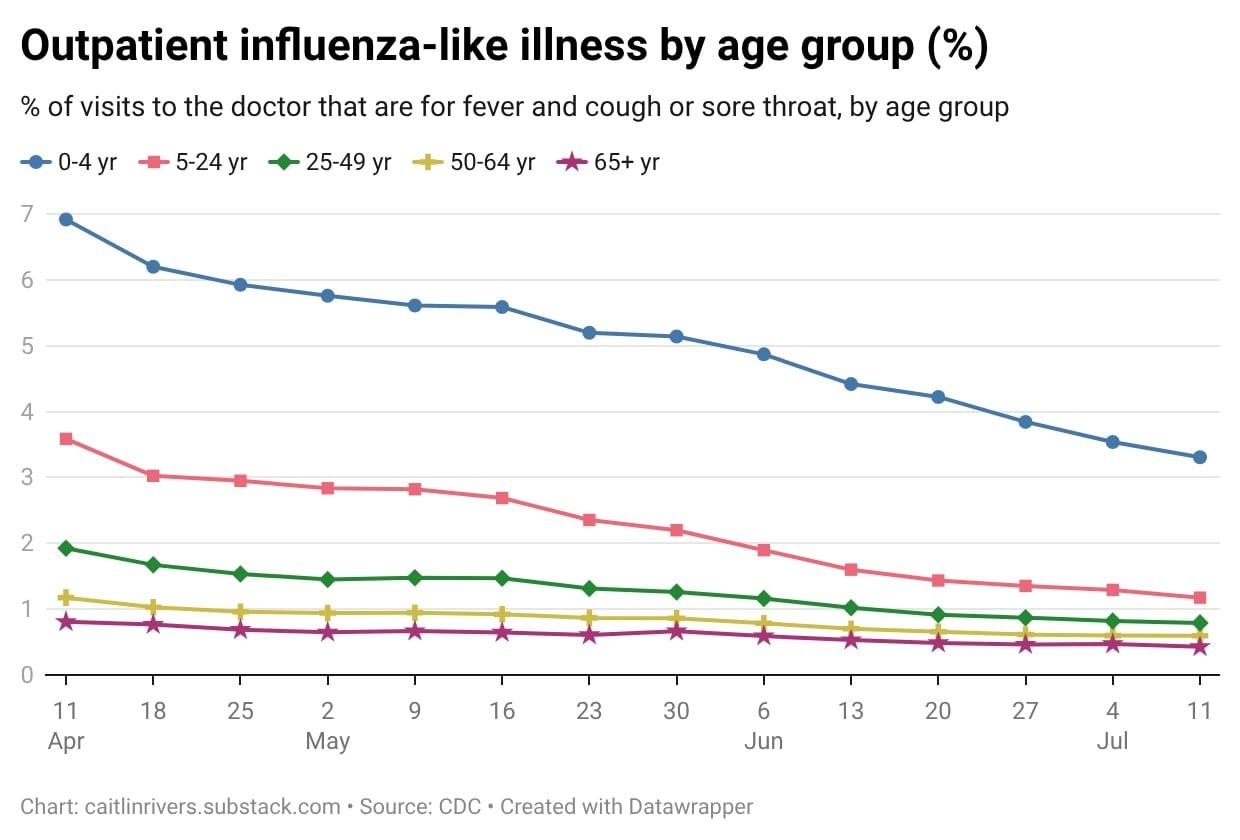
Outpatient ILI for infants and young children under 4 years continues to trend downward towards 3%, while all other age groups are below 2%.
P.S. I made a mistake last week in saying that data had not been posted. It was, I just had my dates mixed up. My apologies!
Covid-19
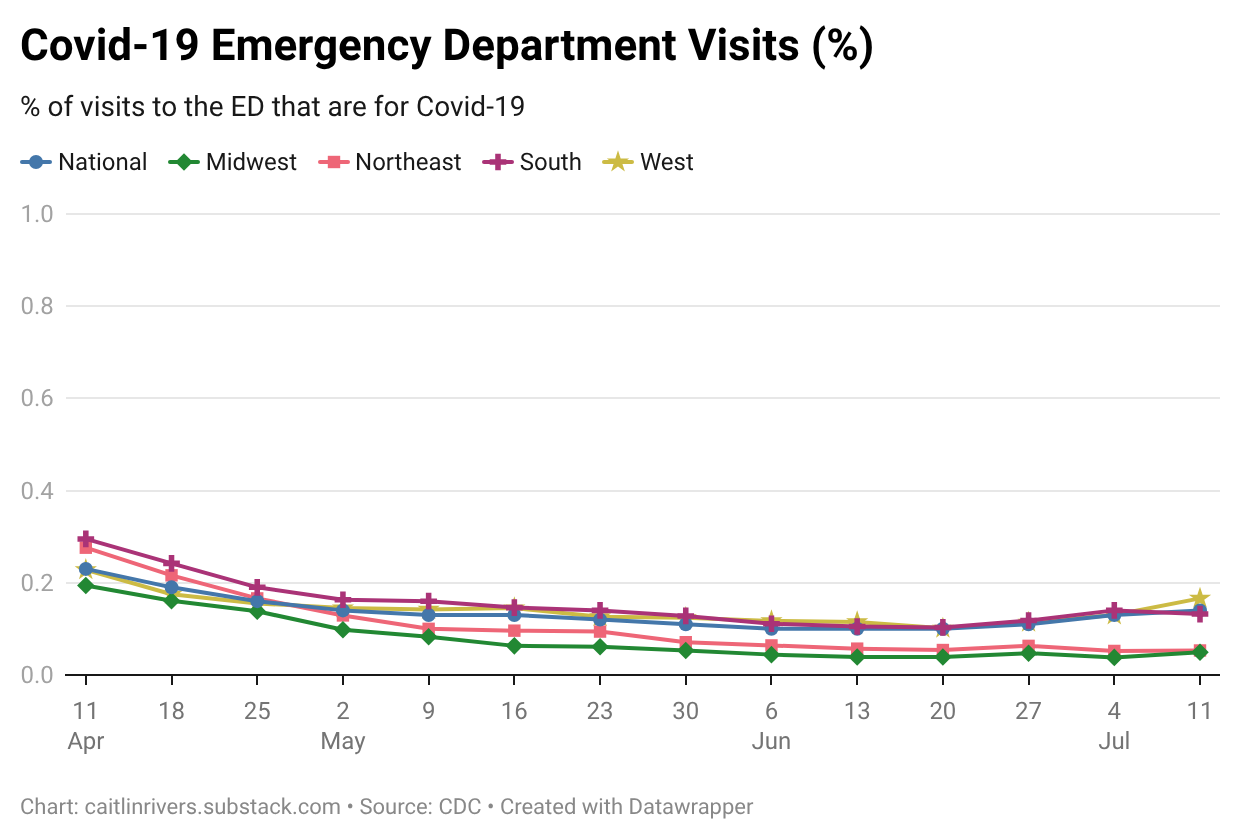
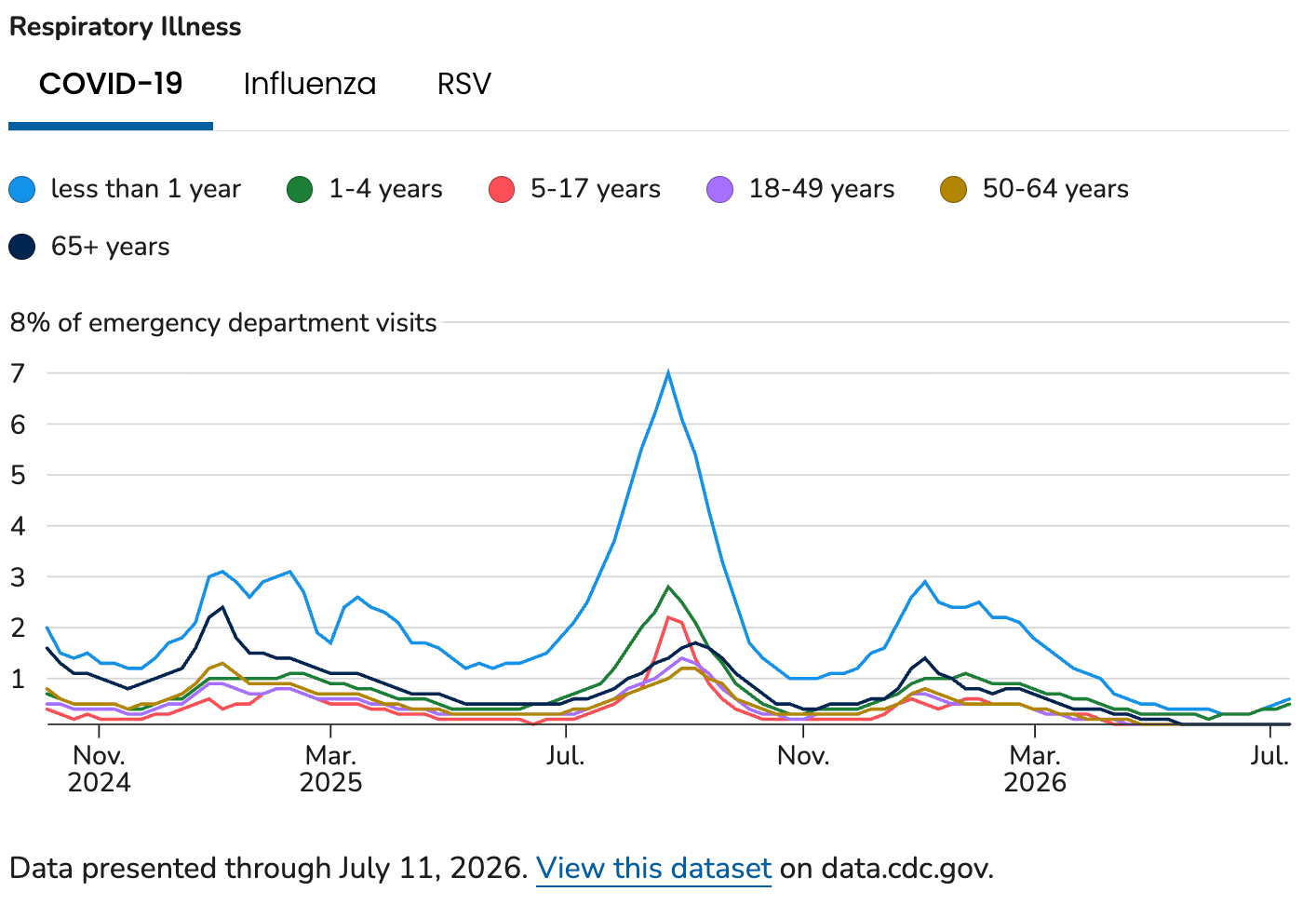
Activity for Covid-19 remains low across the country, with ED visits hovering just below 0.2% and hospitalizations at 0.2 per 100,000. However, there are a few emerging trends that hint towards increased activity in some areas of the country.
ED visits for Covid-19 are drifting up in the Western region, though this is primarily driven by an uptick in Wyoming and Idaho. Data for those states can be misleading, because their small populations make rates sensitive to minor changes. The South is also registering a small increase in ED visits. Those increases are likely to be more "real" because they have appeared for several consecutive weeks. Both regions are seeing rising wastewater concentration for SARS-CoV-2.
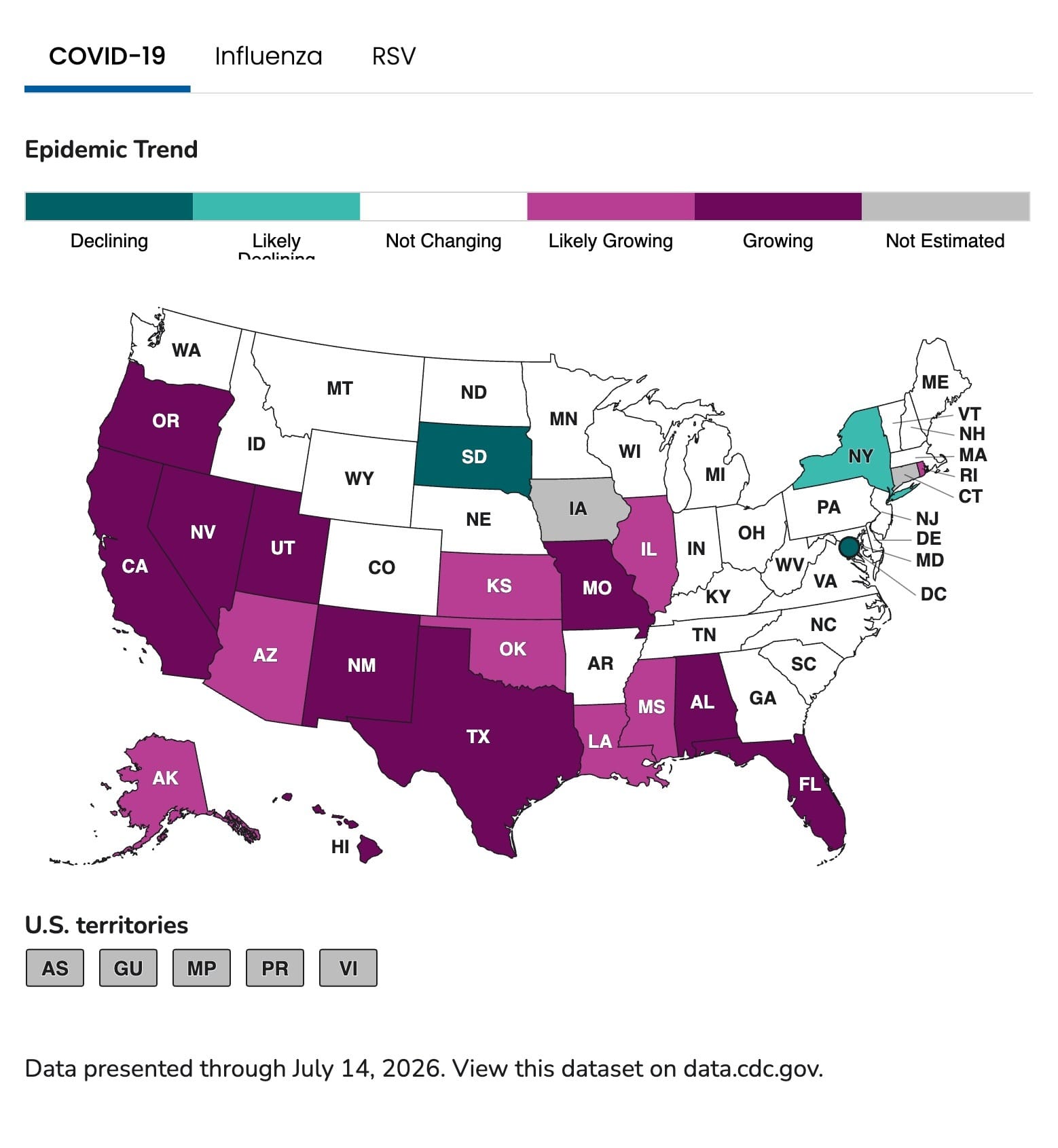
Epidemic trends tracked by the CDC’s Center for Forecasting and Outbreak Analytics support the idea that activity is growing primarily in the South and West. In the Western region, there is growing activity along the southern band of states. Epidemic trends are also growing in the southern portion of the Midwest, and specifically in Oklahoma, Kansas, Missouri, and Illinois. The same goes for the Southern region, with Gulf states now seeing several weeks of increase.
In summary, we are still in the very early days of the summer season. The South and West are currently seeing the most activity. In previous summers, the peak has hit in late August with activity remaining high into September.
As a reminder, Covid-19 is most dangerous to infants and adults 65+, who have had the highest hospitalization rates over the past two years. Right now, though, it's children 4 and under who are seeing the increase in activity, as measured by ED visits, which suggests they may be the group most affected by the current uptick.
RSV
RSV activity remains low across the country. ED visits are steady at 0.1%. Hospitalizations due to RSV are stable at 0.1 per 100,000. All regions are low.
Other Stomach Bugs
- Shredded iceberg lettuce has been identified as the potential source for the current cyclosporiasis outbreak. More below.
- Norovirus test positivity has not been updated since July 4 when it was trending down and hovering around 6.6%.
- Rotavirus test positivity has also not been updated since July 4 when it was trending up and hovering around 2.3%.
Food Recalls
The following foods are being recalled because they are contaminated and can pose a health risk to you and your family. Please check your cupboards and discard any of these items:
- Taylor Fresh Foods Iceberg Lettuce, Cyclospora outbreak (More info)
Previously reported
- GreenWise Organic Blueberries, potential E.Coli Contamination (More info)
- Oribe Serene Scalp Densifying Shampoo, Pluralibacter gergovia bacteria (More info)
- Ready-to-eat chicken Caesar wrap, possible Listeria contamination (More info)
- Clover Hill Dairy all brand cheeses, potential Listeria contamination (More info)
- Nara Organics Whole Milk Infant Formula, potential botulism contamination (More info)
In Other News
Cyclospora outbreaks: On Friday July 17, the US Food and Drug Administration warned against consuming shredded lettuce from Taylor Farms served at Taco Bell restaurants in five states. Subsequently, Taylor Farms announced a voluntary recall involving lettuce products distributed to commercial and retail establishments in 27 states. The retailers involved are not at all clear, as they are identified only by internal brand codes (e.g. "CV"). However, Walmart ("MKTSD") is affected. This is not the first time that Taylor Farms has been connected to foodborne illnesses.
Because the situation is rapidly evolving, I will continue to avoid bagged lettuce products, both from the supermarket and at restaurants. I suspect additional recalls will be issued in the days and weeks ahead.
As a reminder, cyclosporiasis is a gastrointestinal disease caused by a parasite. People get infected with this parasite when they eat or drink contaminated food or water. Symptoms include watery diarrhea, severe stomach cramps, loss of appetite, bloating and increased gas. If untreated, the infection can lead to dehydration and related complications. If it is of interest, here is an interview I did on the cyclosporiasis outbreak with Deutsche Welle, that was also picked up by PBS News.
The number of confirmed cases stretches well into the thousands. Michigan leads with reported cases reaching 5,002 as of July 17, 2026, and 102 confirmed hospitalizations. New York, North Carolina, and Illinois are also among the states with elevated case counts. Please note that we report regularly and more in depth on this outbreak, and other prominent ones, in our sister publication FOI Clinical.
Ebola outbreak in the DRC update: Another health facility was attacked by an angry mob in the Democratic Republic of the Congo (DRC) after a woman died in childbirth. It happened in Nyakunde Hospital in Ituri province, the epicenter of the current Ebola outbreak, a sign of continued mistrust and frustration felt by local communities towards health workers. Lack of trust in the government and misinformation make containing this latest outbreak especially difficult.
Last week, the US Government implemented a DO NOT BOARD order that restricts travel for American citizens coming from the DRC for a three-week period. Americans who show no symptoms of Ebola will be able to return to the United States 21 days after leaving the DRC. Similar travel restrictions may also apply to travelers coming from Uganda and South Sudan. Airport health screenings are already happening in a handful of major airport hubs across the United States (Virginia, Atlanta, Texas, and New York City).
As of July 16, the Centers for Disease Control and Prevention (CDC) reported a total of 2,145 confirmed Ebola cases in the DRC, Uganda and France, and 830 confirmed deaths. Health workers are especially vulnerable to becoming infected with Ebola because they are caring for ill patients. The World Health Organization has reported 119 confirmed Ebola cases, 61 recoveries and 36 deaths among health workers. The good news is that so far 390 patients in the DRC alone have recovered from the disease.
What We Are Reading and Listening To:
Cyclospora: Iceberg lettuce recalled in 27 states and more products may follow, The Guardian
Iceberg lettuce served at Taco Bell in 5 states linked to cyclospora outbreak, CIDRAP
What is cyclospora? Here’s how the parasite spreads, National Geographic
Cancer disparities researchers say federal funding changes have disrupted their work, NPR
What if this Ebola outbreak can’t be stopped? STAT News Opinion
What they need are Ebola fighters, The CommonHealth podcast (27 minutes)
A vaccine for Strep A may finally be in reach, Global Health Now