


Food Recalls
The following foods are being recalled because they are contaminated and can pose a health risk to you and your family. Please check your cupboards and discard any of these items:
- Clover Hill Dairy all brand cheeses, potential Listeria contamination (More info)
- Nara Organics Whole Milk Infant Formula, potential botulism contamination (More Info)
Previously reported
- Clover Hill Dairy Soft Ricotta / Requeson Cheese, potential Listeria contamination (More info)
- Nelson & Isa Lacteos 1lb clamshell packages, potential Listeria contamination (More info)
- TNVitamins & Doctor’s Pride Moringa capsules, potential Salmonella contamination (More info)
- Motor City Pizza Co. 5 Cheese Bread Packs, potential Salmonella contamination (More info)
In Other News
Infant Botulism Outbreak: As of June 13, three states–California, Pennsylvania, and Washington–reported suspected or confirmed cases of infant botulism, one in each state. The babies, who were between two and five months, became ill between April and May. All three infants were hospitalized and treated. No deaths have been reported. These cases have been linked to Nara Organic Whole Milk Organic Infant Formula, a brand sold at Target stores. Infant botulism is a rare but serious illness that affects children under one year of age and can happen when a baby swallows spores of the Clostridium botulinum bacteria. The spore can produce a toxin in the gut, which can eventually reach the bloodstream and provoke a variety of symptoms. In infants, the illness can come on slowly and get progressively worse. It often starts with constipation, but symptoms include poor feeding, drooping eyelids, weak muscle tone, and difficulty swallowing and breathing. Unlike older children and adults, an infant’s gut microbiome is not mature enough to fight and eliminate unhealthy bacteria According to the Mayo Clinic, one of the complication of Botulinum toxin is that it blocks nervous system signals. These signals tell our bodies when to be active and when to relax. Blocking these signals can cause paralysis. Botulism can be deadly when the paralysis blocks signals to the muscles you use to breathe.
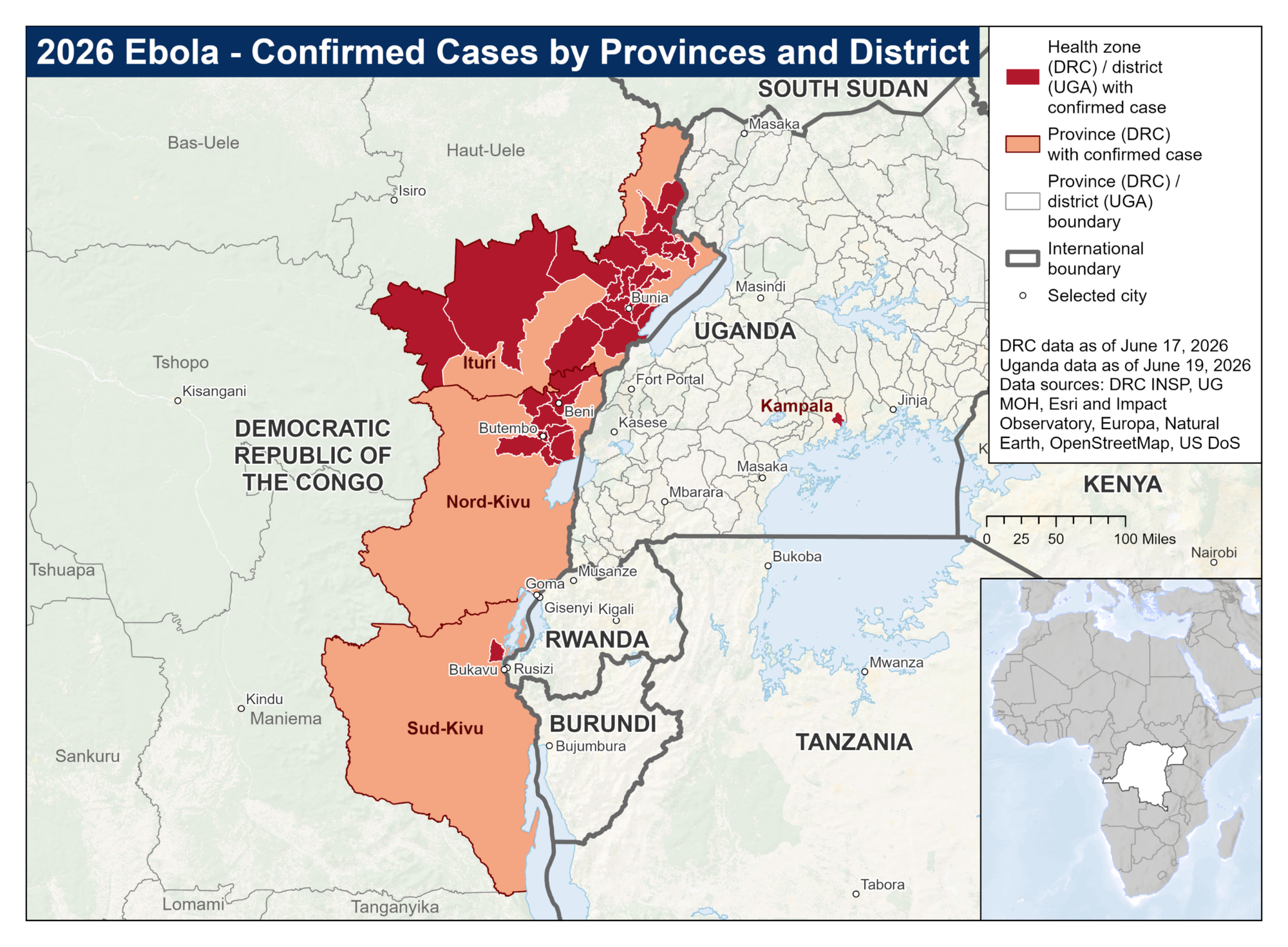
Ebola outbreak update: It has been over one month since the World Health Organization declared this Ebola outbreak to be a public health emergency of international concern. As of June 19, there have been 915 confirmed cases of Ebola caused by the Bundibugyo virus and a total of 234 confirmed deaths in both the Democratic Republic of the Congo (DRC) and in Uganda. Though the majority of the reported Ebola cases have been in the DRC (See case map below), some also been reported in neighboring Uganda and the risk to the region remains high, especially because borders are porous and hard to monitor.
Ebola disease is spread through direct contact with the body fluids of a person who is sick or has died from Ebola. Health workers are especially at risk of being infected with Ebola because of their role in caring for ill patients. More than 70 medical professionals have already been infected with Ebola in the DRC. At least 17 of them have died from the disease in the past month. The risk of the spread of Ebola to the United States is considered low at this time.
Seafood and foodborne illnesses: A new study published last week in the Morbidity and Mortality Weekly Report examined over 400 foodborne outbreaks caused by “marine toxins” in fish and shellfish over a period of 13 years (2011-2023) and found 1,280 illnesses, 96 hospitalizations and one death. Marine toxins are toxic compounds produced by microorganisms that grow in water and are often found in fish and shellfish. Marine toxins are the most commonly reported cause of noninfectious disease outbreaks in the United States. Freezing or cooking seafood does not always destroy marine toxins.
Scombroid toxin and ciguatoxin cause the most reported outbreaks, illnesses, and hospitalizations of all marine toxins. The study found that more than half of scombroid toxin outbreaks were caused by imported fish and fish prepared in sit-down restaurants. Most ciguatoxin outbreaks were caused by reef fish, fish that were not imported, and fish prepared in private homes. Outbreaks attributed to shellfish-associated toxins were not imported and were prepared in private homes. The findings of this study can be used to guide food safety prevention efforts and raise awareness about marine toxins and related illnesses. Some outbreaks can be prevented by maintaining temperature control of seafood below 40 degrees Farenheit from catch to consumption. Reducing the harvesting of reef fish and shellfish from high risk areas, during and immediately after harmful algal bloom, can also prevent illnesses from marine toxins.
What We Are Reading and Listening To:
New infant botulism outbreak puts fancy formulas under scrutiny (STAT News): https://www.statnews.com/2026/06/18/byheart-nara-botulism-outbreaks-premium-baby-formula-safety/
Hospitals see diseases resurge as vaccinations decline (New York Times gift article): https://www.nytimes.com/2026/06/02/well/children-vaccines-illnesses.html?emc=edit_ufn_20260615&nl=from-the-times&segment_id=221518
DR Congo’s deadly Ebola outbreak is ‘evolving fast,’ WHO warns (France 24 News): https://www.france24.com/en/africa/20260619-dr-congo-ebola-outbreak-evolving-fast-who-warns
Moderna’s mRNA flu vaccine gets thumbs up from federal vaccine panel (CIDRAP): https://www.cidrap.umn.edu/influenza-vaccines/moderna-s-mrna-flu-vaccine-gets-thumbs-federal-vaccine-panel
A system held by duct tape (Osterholm update podcast): https://www.youtube.com/watch?v=O9xBHMpZcDQ