


Welcome to Outbreak Outlook! This is the free, national version. Paid subscribers can access regional editions of the newsletter, which contain more local information. Not signed up yet but interested in getting the regional insights? Subscribe and follow these easy instructions at this link.
Influenza-like illness
This week, influenza-like illness (ILI) activity decreased markedly. 4.7% of visits to the doctor were for symptoms such as fever, cough, or sore throat, down from the previous week's rate of 5.2%. The current ILI activity level is comparable to what we saw in early December.
Although there is a possibility that ILI activity will rebound like it did during the 2018-2019 and 2019-2020 seasons, I am growing more confident that we have passed the peak. (We may still see a surge of influenza B, which typically causes a smaller wave during the spring months.)
By age: ILI activity decreased across all age groups. Even kids between the ages of 0 and 4 saw significant improvement, with a drop in ILI from 16% to approximately 11% over the last two weeks. Activity has also fallen in people ages 5 to 24 to 6%. Older age groups are all below 5%.
By region: In all four regions of the US, ILI activity is decreasing. In the Southern region, which was hit hardest initially, states are transitioning from very high to high ILI levels, except for Tennessee, which continues to experience very high levels of activity. The Western region is improving, but California still reports a high level of ILI activity. Similarly, the Midwest and Northeast regions are showing progress, with the notable exception of New York City, which has consistently maintained high ILI activity levels.
By severity: As you might expect from the across-the-board improvements, influenza-related hospitalizations are falling as well. The number of new admissions fell from approximately 20,000 per week at the turn of the new year to 14,000 according to the most recent dat1. Sadly, there have been 47 influenza-associated pediatric deaths reported this flu season. Across all age groups, the number of influenza deaths reported so far this season is 2,721.
COVID-19
Covid-19 activity is beginning to recede. I tentatively think we have passed peak for this virus, too. There are multiple lines of evidence that support this conclusion. First, wastewater concentration is decreasing, according to data from Biobot. The number of new weekly hospitalizations for Covid-19 has also fallen from around 36,000 to 33,000. Finally, test positivity and emergency department visits are also dropping. These indicators suggest that we have probably reached a turning point in this winter's wave—though activity still remains high for now.
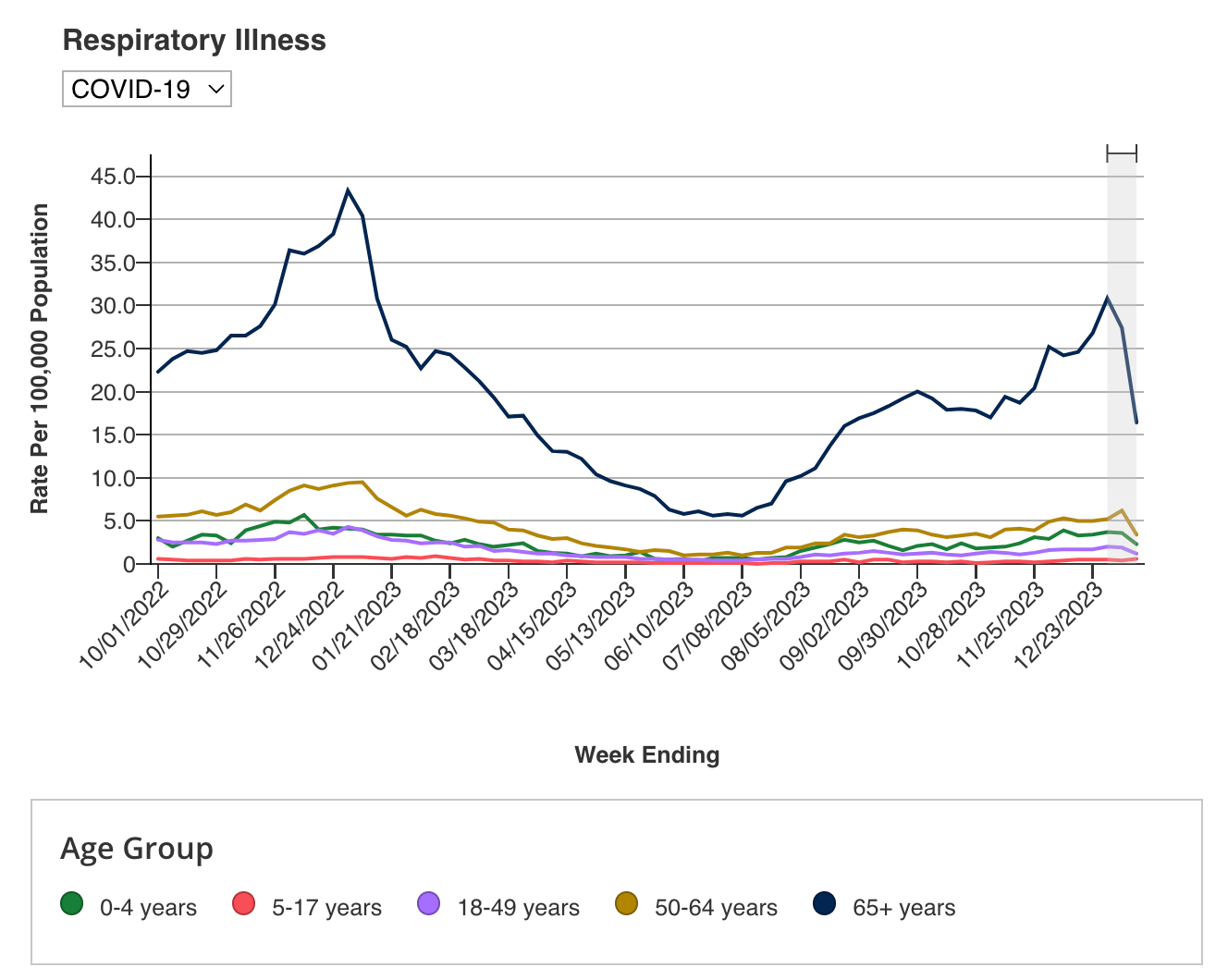
Notably, the most significant improvements in trends are in people ages 65 and older, who are at higher risk of hospitalization. As of the week ending January 6, approximately 4.4% of all deaths in people over 65 were attributed to Covid-19 (the dark blue line below). However, recent data is still being collected and reported, so the numbers may change.
Despite the decreasing activity, vaccination rates for the updated Covid-19 vaccine remain low, with only 22% of adults covered. Interestingly, 13% of people surveyed said they would definitely get vaccinated and 28% said they would likely get it or were undecided. If you fall into one of these groups, it's not too late to benefit from vaccination this season. But for next year, I suggest planning to get it during the autumn.
RSV
I am relieved to see continual improvement in RSV trends. The PCR test positivity rate has fallen to 8%, down from nearly 10% the week prior. Nationwide, we hit 12% in mid-December, which is now recognizable as the peak. Emergency department visits for RSV has fallen as well, now to levels last seen around Halloween time.
Looking ahead, I expect RSV activity to continue to decline. I would like to see test positivity below 5%, and I estimate it will be another two weeks to reach that point for most of the country. However, the Midwest has not advanced as far through the season, so it may be a month or more before they see that lower level of activity.
By age: Children ages 0–4 have the highest rates of hospitalization for RSV. Trends have improved considerably for that age group. There have also been improvements in the 65-plus age group, which is the second most affected by severe RSV.
By race and ethnicity: This season, American Indian/Alaska Native individuals were at the highest risk of hospitalization from RSV, followed by Hispanic individuals. Since November and December, hospitalization rates for these groups have improved, reflecting a decrease in overall RSV activity.
Norovirus
There's an unexpected bright spot in the stomach bug category, with norovirus activity falling across the country in recent weeks. All four census regions have seen a recent decline in PCR test positivity for norovirus. I'm not confident that it will stick, given that norovirus usually remains high through late winter and early spring, but I would be delighted to be wrong in this case. National test positivity is down to 9.8%, following a two-week decline from 13.1% at the end of last year.
Other bugs
- Seasonal coronavirus activity, a frequent cause of the common cold, is increasing rapidly, which is typical for this time of year. Expect some stuffy noses in the weeks ahead.
- Human metapneumovirus and parainfluenza virus, two causes of influenza-like illness, remain low. Adenovirus activity also appears to remain low.
Food recalls
The following foods are being recalled because they are contaminated. Please check your cupboards and throw out any of these items:
New
- Brightfarm Spinach and Salad Kits (more info)
- Charcuterie meats sold by Fratelli Beretta and, newly, Busseto (more info)
Previously reported:
- Tons of different granola and oatmeal products from Quaker -- more items were added to the list of contaminated products (more info).
- Ground beef sold by Valley Meats and Scanga Meat (more info, more info)
- Pet food sold by Blue Ridge Beef (more info). Pet food can pose a risk to humans through cross contamination.
- If you have food allergies, you may wish to review these FDA safety alerts and USDA alerts for foods with undeclared allergens.
In other news
- Measles clusters across the country are alarming public health officials, with cases and exposures now spanning multiple states. The Philadelphia Department of Public Health is tracking an outbreak that begin in an individual who contracted the disease abroad and subsequently exposed others in a hospital and daycare. In Camden County, New Jersey, officials are monitoring a confirmed case, though its connection to the Philadelphia outbreak is unclear. Delaware officials have reported potential exposure to 20-30 people at Nemours Children’s Hospital in Wilmington. Virginia's Health Department also issued warnings for potential exposures at Dulles International and Ronald Reagan Washington National Airports. In southwest Washington state, as many as six measles cases were linked to a family gathering. Separately, the UK is also seeing a resurgence of measles affecting hundreds of people in recent months and leading to significant hospitalizations of children in Birmingham.
- A recall of cinnamon applesauce pouches has expanded considerably. As of January 16, the FDA has recorded 89 cases of lead poisoning linked to recalled WanaBana, Schnucks, or Weis brand cinnamon fruit pouches. CDC’s tally, which includes confirmed, probable, and suspected cases, is 354 cases across 41 states. The pouches were manufactured in Ecuador and have been found to contain elevated levels of lead and chromium.
- It’s been a busy few weeks for long covid news. A Senate hearing convened by the Health, Labor, Education, and Pensions Committee was well attended by advocates and experts hoping to raise awareness and marshal additional resources for long COVID treatment and prevention. There have also been a number of important scientific advances in understanding long covid: two fellow substack colleagues, Eric Topol’s Ground Truths and Katelyn Jetelina’s Your Local Epidemiologist, have the details.

The data stream I use does not capture all influenza-related hospitalizations, so it is most useful for monitoring trends and not total burden. ↩