Respiratory Diseases
Influenza-like illness
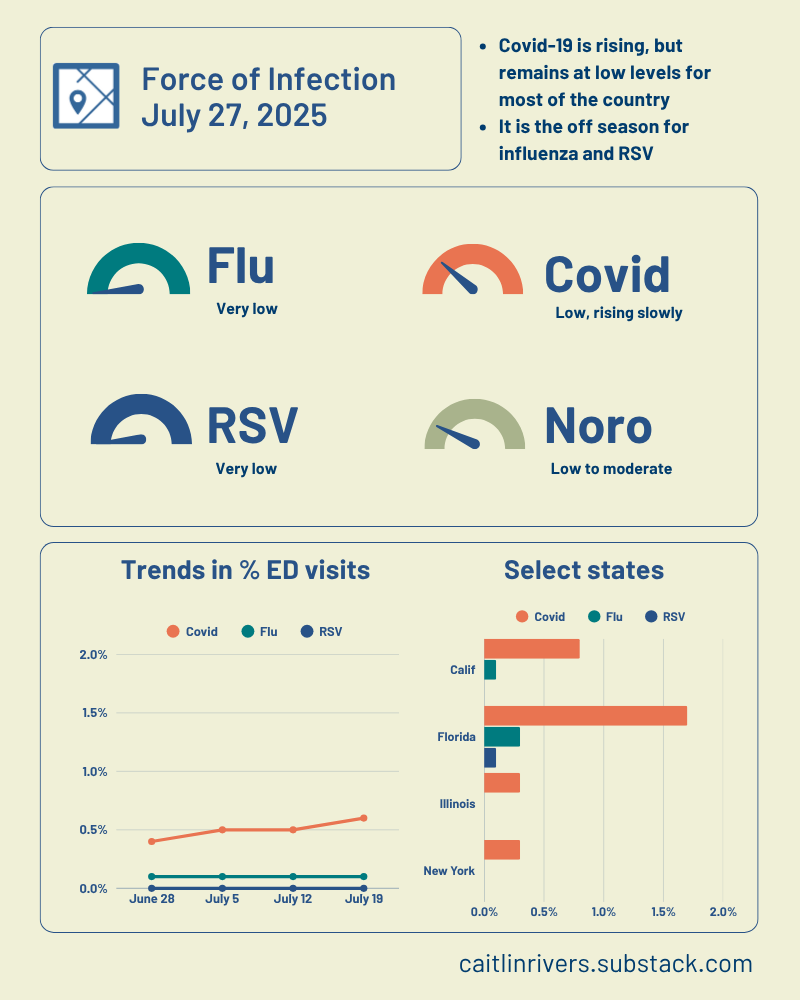
Enjoy the summer break from flu. Outpatient influenza-like illness visits have dipped to a very low 1.0% overall. (As a reminder, that metric represents the percentage of visits to the doctor that are for fever and cough or sore throat.) Every state is reporting minimal influenza activity, with very low or low wastewater activity.
Outpatient ILI visits have declined further to 3.2% among babies and young children aged 0 to 4, and to 1.3% for those aged 5-24. For all other age groups, ILI accounted for <1% of outpatient visits.
Hospitalizations are near-zero at 0.2 hospitalizations per 100,000 people.
COVID-19
Overview
Despite increases across several indicators over the past month, activity remains low across most of the country. Higher activity is currently concentrated in a handful of states, including Hawaii and Florida.
At the national level, the percentage of visits to the emergency department that are for Covid-19 has increased slightly over the past few weeks to 0.6%, and more than a dozen states reported increases this past week. Hospitalizations remain fairly flat and low at 1.3 hospitalizations per 100,000 people nationally.
Regional
Wastewater activity is low in the West, with a few exceptions. In Hawaii, wastewater activity is high, having dipped a bit from very high activity last week. ED visits are up to 2.1% and hospitalizations in the state have sharply increased as well to 4.4 hospitalizations per 100,000.
In California wastewater activity has declined slightly, to moderate levels. However, ED visits have risen to 0.8%. This level is still fairly low, but it exceeds this winter’s high of 0.6%. The rest of the West looks fine.
Wastewater activity is low at the regional level in the South, but several states have increased activity. The school year begins soon for many Southern states, so it’s something to look out for.
In Louisiana, wastewater activity is very high, approaching levels last reached during 2024’s summer wave. ED visits are also rising, now to 1%.
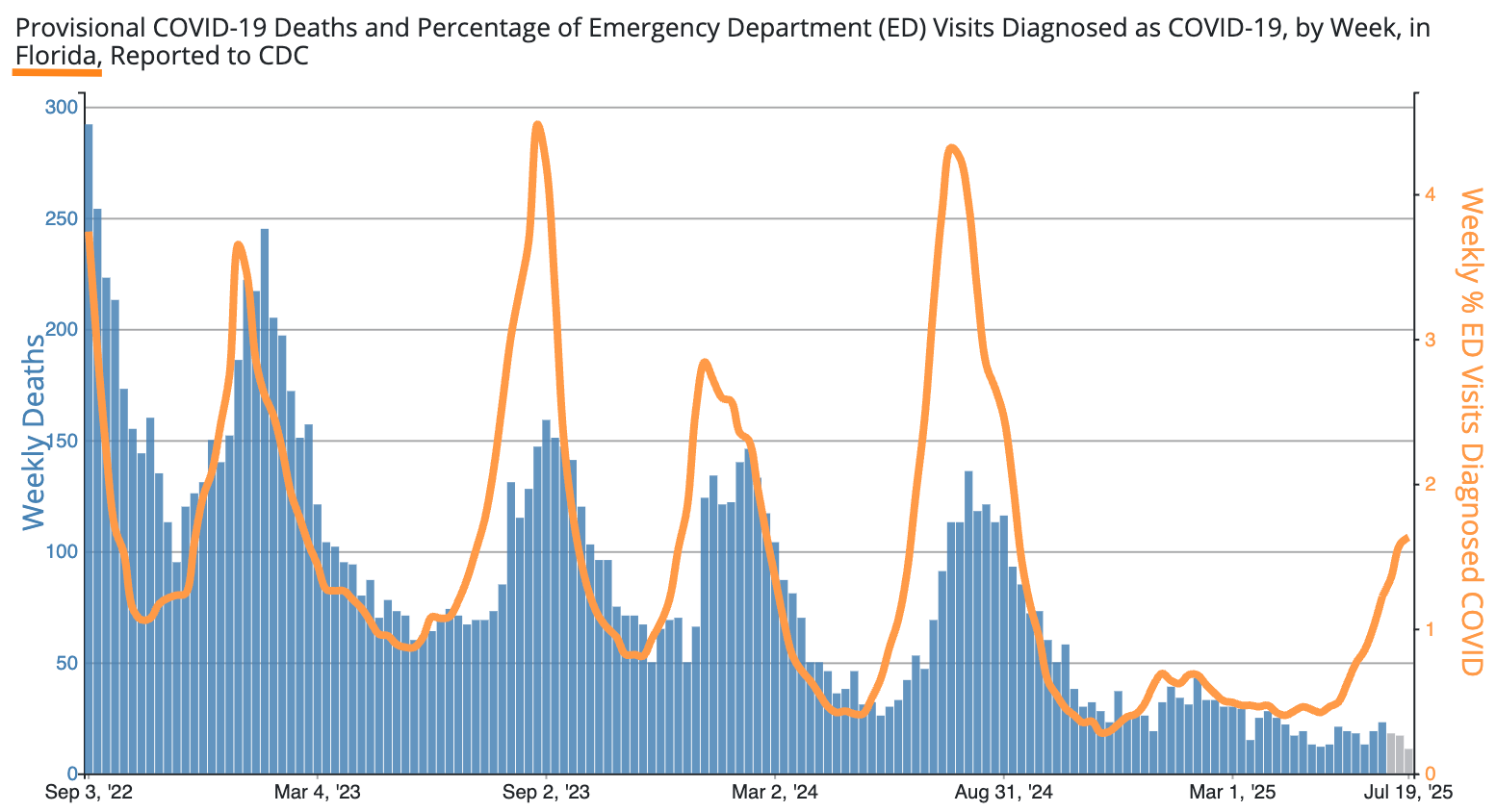
Florida has seen the most activity for several weeks now and continues to increase. ED visits have risen to 1.6%, up from a recent low of 0.4%. This level far exceeds the state’s very small winter wave. Hospitalizations are also up, now to 3.8 per 100,000. There are no signs of slowing yet.
Wastewater activity is moderate and ED visits remain low but are rising in Kentucky, Texas, and South Carolina. Other states in the region are seeing lower levels of activity.
Wastewater activity has climbed from very low to low in the Midwest and Northeast, but there is not a single state in either region reporting moderate or higher activity.
Outlook
My hypothesis was that the weak winter wave would set the stage for a bigger summer, because many people would not have recent immunity. So far, activity has been more sedate than I anticipated. I remain open-minded about what August will bring. My best guess is continued increases until early September, but I am uncertain. I’ll let you know what the data show.
RSV & Other Bugs
RSV: All quiet, with no signs of an increase yet. RSV tends to pick up in the early fall, so I will be looking for increasing activity in the next two months.
Other Bugs: Most of the causes of cold- and flu-like illness are really quiet right now.
- Human coronavirus, human metapneumovirus, rhinovirus/enterovirus, and adenovirus activity are all low.
- Parainfluenza is still a bit elevated but has declined by more than half in the past few weeks and is moving into a quieter period.
Norovirus
There was a glitch with the data this week, it’s only showing information for May. My backup data source shows a sharp increase, but I’m not worried. I’m thinking it will smooth out next week.
A reader asked recently why this year has been unusually active for norovirus. I phoned a friend, epidemiologist and professor Dr. Ben Lopman at Emory University for details. He says,
“Norovirus activity typically peaks in the winter, but both the timing and intensity of these peaks vary from year to year—including during the summer months. This year, we’re seeing elevated levels of norovirus, which are often linked to the emergence of a new strain. In this case, a variant known as genotype II, genotype 17 (GII.17) has become the predominant strain.”
So there you have it. Variants strike again.
Food recalls
The following foods are being recalled because they are contaminated. Please check your cupboards and throw out any of these items:
New:
- Canned sliced peaches under the Parashore label (more info)
- Tuna salad trays and sandwiches sold at Albertsons, Tom Thumb, and Randalls stores in Arkansas, Louisiana, Oklahoma, and Texas (more info) and at Jewel Osco stores in Illinois, Indiana, and Iowa (more info)
Previously reported:
- Frozen sprouted beans - “Deep Sprouted Mat(Moth)” and “Deep Sprouted Moong” (more info)
- Dry salted whole fish, sold as Dry Salted Vobla Aral Silver (more info)
- Emek Spread Pistachio Cacao Cream with Kadayif (more info)
- Needle mushrooms (more info)
- Ready-to-eat chicken sausages sold by Kayem Foods (more info)
- If you have food allergies, you may wish to review these FDA safety alerts and USDA alerts for foods with undeclared allergens.
In other news
Salmonella outbreak linked to unpasteurized/raw milk consumption. Researchers have linked an outbreak of Salmonella in California in 2023-2024 to consumption of unpasteurized milk products from a single farm. The researchers identified 171 cases (159 confirmed, 12 probable) tied to this outbreak. Most of the individuals affected were children (70%), and children made up the vast majority of known hospitalizations. Of the 91 patients who were interviewed, 79% reported consuming unpasteurized milk products, and of those, 93% reported consuming products from that specific farm in the week before their illness. Consumption of unpasteurized or raw dairy products can cause several different infections; pasteurization renders dairy products safe to consume.
Cluster of Legionnaires’ disease in New York City. 5 cases of Legionnaires’ disease have been identified in Central Harlem and more potential cases are undergoing testing. Legionnaires’ disease does not spread person-to-person. It spreads through inhalation of water vapor, often originating from large cooling towers. While most people who are exposed won't become ill, it can cause pneumonia or severe flu-like symptoms, particularly in older adults, smokers, and people with lung conditions or weakened immune systems. During an outbreak, public health officials identify and treat the contaminated water source and ensure infected individuals are diagnosed and receive appropriate antibiotics.