

Flu season is off to its earliest start in years, and activity is very different from state to state. The regional editions cover what’s happening where you live, across flu, Covid-19, RSV and more. Try them free for 7 days, then get any or all four regions every week through the winter for $5 a month or $60 a year. Cancel online anytime. Learn more about regional editions.
Influenza
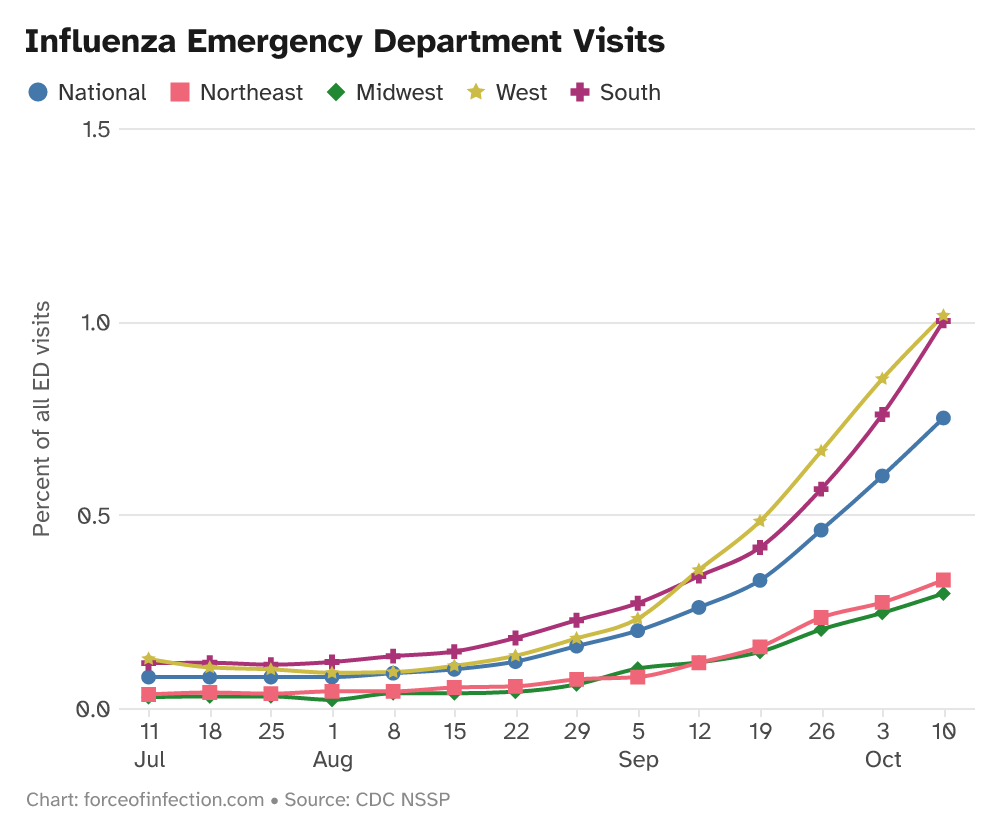
Influenza continues its early season surge with unseasonably high activity in the West and South. Although outpatient influenza-like illness (ILI) is still modest at 2.1% nationally, test positivity has doubled in the last three weeks, and in Region 9 (Arizona, California, Hawaii and Nevada) it now surpasses 10%.
New this week: the South is making a play to catch up to the West. Emergency department visits for influenza are 1.0% in both regions. This is dramatically higher than the same week last year when activity was 0.3% and 0.1% respectively. In fact, ED visits are approximately six weeks ahead of last year. The South has also now passed the West for influenza hospitalization rates.
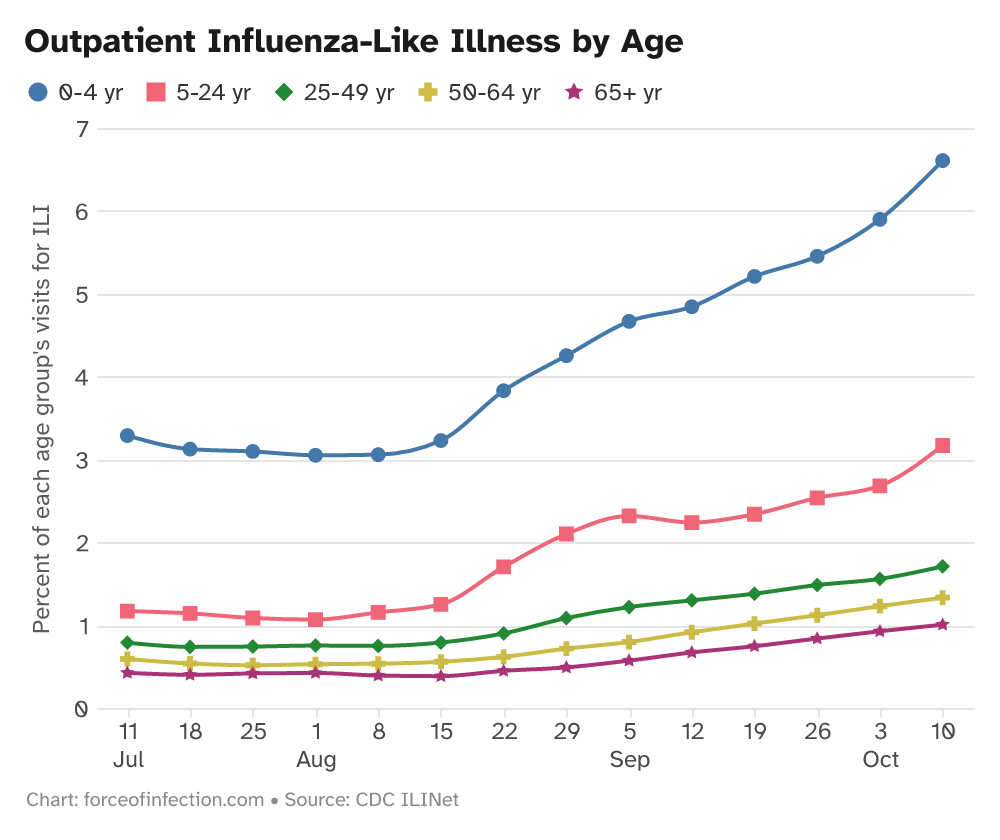
Activity is increasing across all age groups, but as always, children ages 0-4 have the highest rates of outpatient ILI. They jumped from 5.9% to 6.6%. This is more than one percentage point above the same week last year. Activity in people ages 5-24 is also growing quickly, now at 3.2%. Older age groups are all 2% and under.
COVID-19
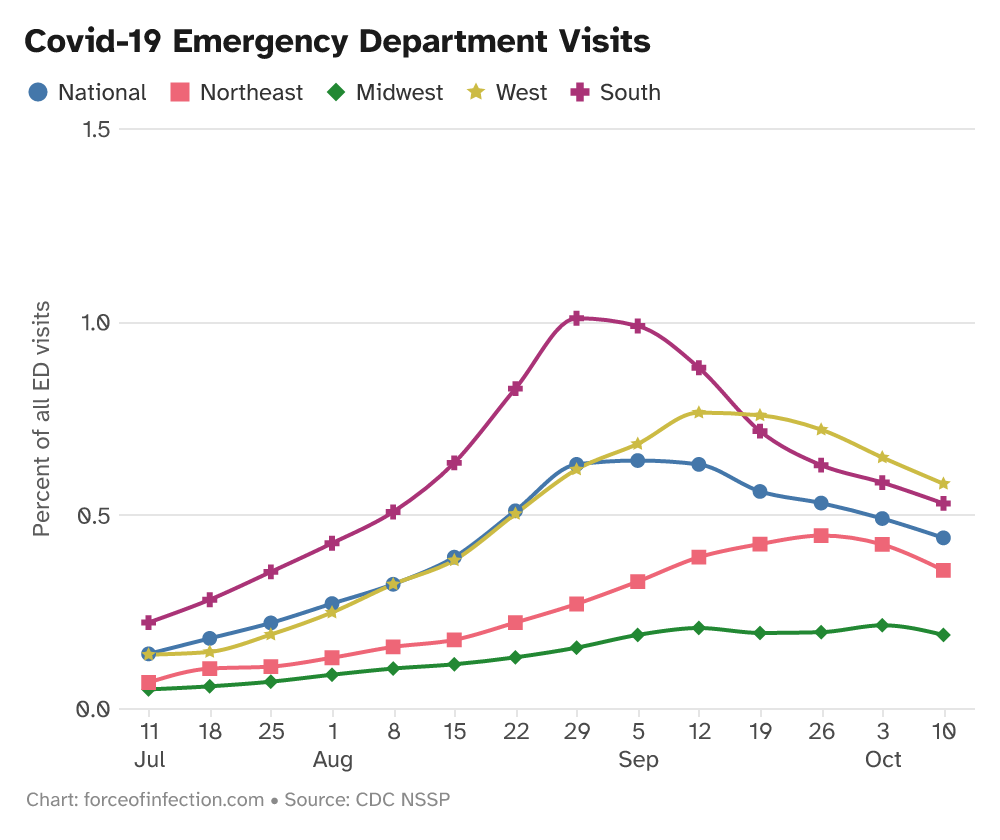
Thankfully, given the influenza situation, Covid-19 activity is relatively quiet. Emergency department visits for Covid-19 are flat or trending down in all four regions of the country. Wastewater concentration is stable or declining in most regions as well, with the exception of the South, which is moderate and stable.
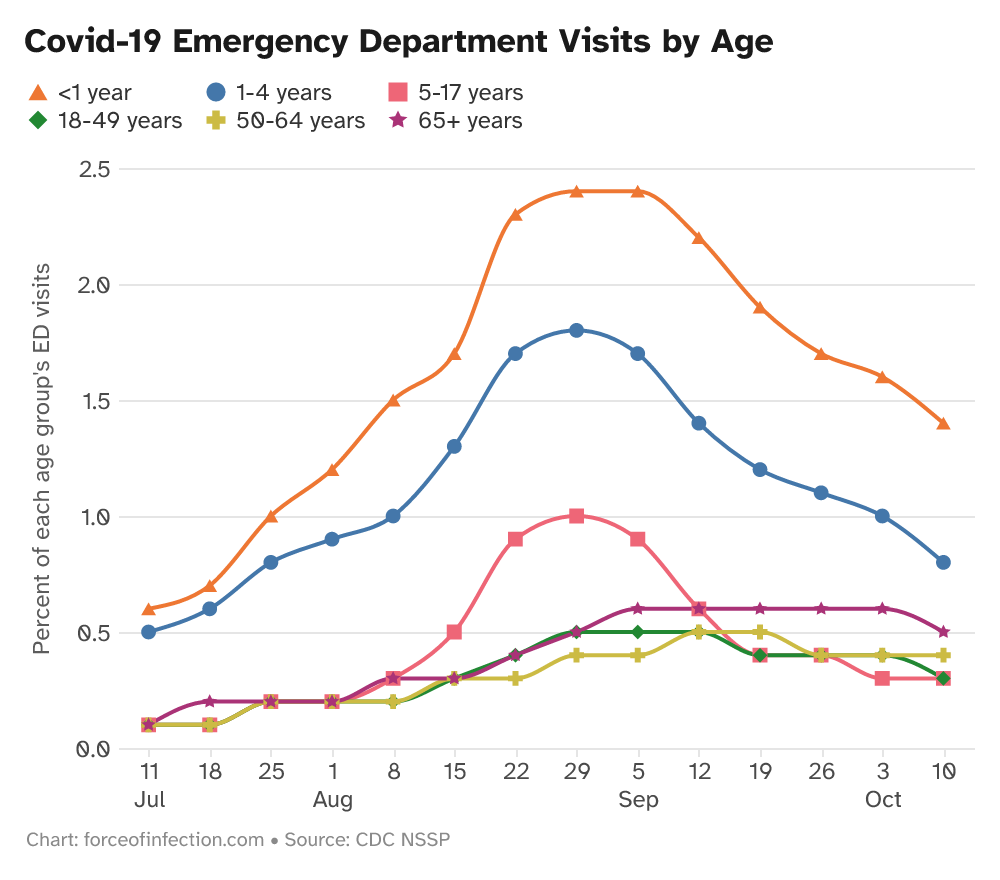
All age groups have seen substantial declines in emergency department visits and hospitalizations for Covid-19 since the August/September peak. However, children remain most affected, as measured by ED visits. Older adults have the highest rate of hospitalization.
RSV and other respiratory pathogens
RSV activity remains very low nationally, but there are early signs of the season starting, mainly in the South. RSV hospitalization rates in the South have more than doubled since mid-September, to (a still low) 0.3 per 100,000, while the other three regions remain flat.
Nationally, infants and young children are most affected. RSV now accounts for 0.7% of emergency department visits among infants under 1 and 0.6% among children ages 1-4, up from about 0.2% to 0.3% in late summer.
CDC estimates that RSV activity is growing nationally.
Stomach Bugs
Norovirus test positivity increased slightly to 8.6% from 8.5% the week prior. Rotavirus activity is low and stable.
Food Recalls
New:
- Cold Smoked Salmon from Starfish Seafood (more info)
- Raw Mild Cheddar Cheese from Family Farmstand (more info)
Previously Reported:
- Broccoli Seeds - Calabrese from Eden Brothers (more info)
- Broccoli Sprouting Seeds from Gardeners Basics (more info)
- Cold Smoked Salmon, Halibut, and Trout from Starfish Seafood (more info)
In Other News
- The first set of regional editions of the season went out to paid subscribers earlier today. Regional editions contain detailed, state-level information about flu, Covid-19, RSV and more.
- If you would like to receive regional editions for $5/mo, follow these instructions. You can cancel online any time.
- If you were expecting a regional edition but did not receive it, begin by checking your spam folder. Then, confirm your regional selections using these instructions. If you're stuck, write to support@forceofinfection.com. (Please be courteous! I promise we will do our best to solve your problem.)
- Paid subscribers can view regional editions online anytime at forceofinfection.com. Here are the direct links to today's for easy access: South | West | Northeast | Midwest
- Kenya has confirmed seven cases of Ebola caused by Bundibugyo virus, all linked to the large outbreak in the Democratic Republic of the Congo. The first patient, a traveler who had recently been in the DRC, was confirmed on October 6 and later died. Six close contacts have since tested positive, including family members and three health workers. Most were already in quarantine when they developed symptoms. Health officials say there is no evidence of community transmission and the risk to the public is low, and 128 of the first patient's 130 contacts have been traced and quarantined. The outbreak in the DRC has reported 300 cases and 4,481 deaths as of October 14.