Influenza-like Illness + RSV
Flu remains very low: wastewater activity is minimal, and outpatient visits for influenza-like illness remain below baseline, at 1.9% of all outpatient visits.
RSV is slowly starting to increase, but still remains at minimal levels.
Covid-19
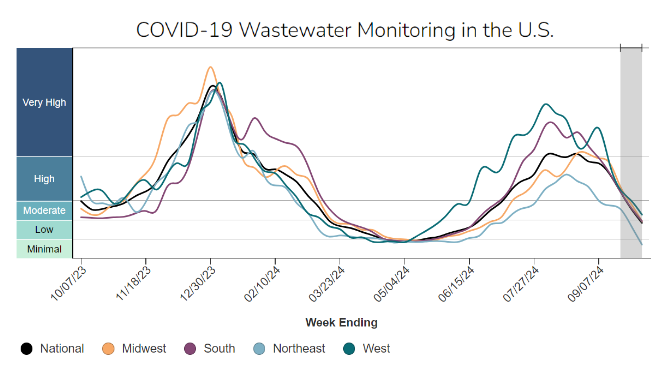
Finally! Covid-19 is way down. Wastewater activity is low nationally for the first time since late June. Nearly half of all states are reporting low or minimal wastewater activity. Rates remain highest in the Western region and lowest in the Northeastern region.
More severe illness has fallen. ED visits decreased again this past week, down to 0.8% of all ED visits. Hospitalizations have also declined to low levels: 1.2 hospitalizations per 100,000 people.
Quick note about hospitalization data this week: the numbers for some states seem a bit off and I think there are some reporting lags. As such, I’ve refrained from commenting on hospitalization data for several states (Ohio, Minnesota, and Oregon) and those that I have reported, I’d take with a grain of salt and check back again next week.
Western Region
Wastewater activity has declined to moderate levels for the region, and in most states in the region, Covid is calming down. Wastewater activity is low in Utah, Colorado, California, and Alaska and minimal in Hawaii and Nevada. Activity is still high in Washington and very high in Montana, but rates are declining in both.
However, activity is high and increasing in Idaho, Wyoming, and Arizona (limited coverage), and is stable at a very high level in Oregon.
ED visits are down to minimal levels across most of the region, with all states reporting either stable or decreasing rates. In California, hospitalizations have declined to 0.3 per 100,000, which is lower than they’ve been at any point in the past 2 years.
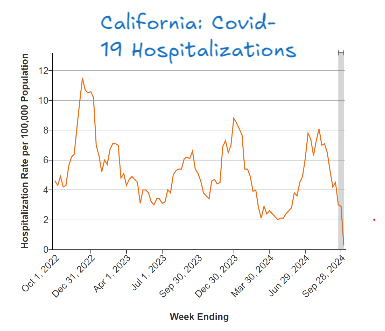
Hospitalizations also declined again in Colorado (to 1.3) and New Mexico (2.3), and held steady in Utah (2.2).
Southern Region
Wastewater activity is low regionally and in most states in the region, including Texas, Florida, Georgia, Alabama, South Carolina, Tennessee, and Virginia. Rates are minimal in Washington, DC, and Mississippi (limited coverage). Rates are moderate in Maryland, North Carolina, Kentucky and Louisiana. While rates are decreasing, they remain very high in Oklahoma and high in Delaware.
There are exceptions to these improvements: activity is high and increasing in both Arkansas and West Virginia.
Severe illness has dropped as well. ED visits are minimal and decreased in every state in the region. Hospitalizations are down in Maryland (1.2 per 100,000), Georgia (0.5), and Tennessee (0.9).
Midwestern Region
Wastewater activity has dropped to low levels. Activity is minimal in Illinois and low in Iowa, Missouri, Kansas, and Indiana. It is moderate in Wisconsin, Nebraska, Ohio and South Dakota (limited coverage). It remains high but is decreasing in Minnesota.
Michigan (which has limited coverage) is the outlier this week. After being below the regional average throughout this wave, its wastewater activity spiked last week to high levels. However, hospitalizations have decreased in the state to 2.7 (from 5.4 just 3 weeks ago).
Severe illness is on the decline: visits to the ED for Covid-19 decreased moderately or substantially across most of the region, and held steady in Nebraska and Kansas. No Midwestern state reported an increase in ED visits.
Northeastern Region
Wastewater activity has dropped to minimal levels and is lower now at the regional level than it was even during the lull this spring and early summer.
Activity is minimal in New York, New Jersey, and Rhode Island. It is moderate in Connecticut and Pennsylvania (limited coverage). While activity remains high in Maine, New Hampshire, Vermont, and Massachusetts, it is decreasing in all of these states.
There were substantial declines in ED visits in every state in the region. In New York, hospitalizations are slowly coming down; the rate is 6.5, down from 8.6 three weeks ago. Hospitalizations also decreased in Connecticut, to 2.7 per 100,000.
Norovirus
Norovirus rates keep increasing: we are up to 9.3% test positivity nationally. This increase is being driven primarily by the South, where rates have shot up to 17.8%. This is higher than at any point in the last year.
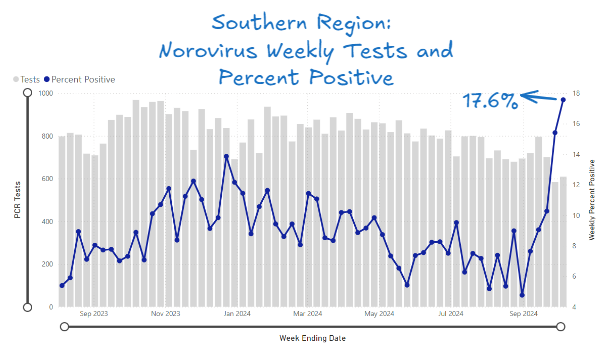
In the Midwest, test positivity stayed roughly steady this past week, at 7.7%. In the West, test positivity declined slightly to 6.9%. In the Northeast, test positivity has increased slightly to 3.2%.
A reminder as cases increase: norovirus causes stomach pains, diarrhea, and vomiting. It is extremely transmissible via bodily fluids and through contaminated surfaces, food, and water.
- To reduce your odds of getting sick, remember to wash your hands frequently with soap and water for at least 30 seconds (norovirus is able to withstand hand sanitizer).
- If you or someone in your household becomes sick, wash hard surfaces with soap and water or a diluted bleach mixture, and wash soiled clothing and linens in hot water and then dry on high heat.
- Norovirus is still highly transmissible for several days after symptoms improve or go away. As such, insofar as is possible, avoid preparing food for others for at least 72 hours after symptoms end. Longer is better: it can spread up to two weeks after symptoms end, though it is most transmissible during those first few days of illness and after symptoms resolve.
Other Respiratory Infections
Cold season is upon us. Several of the viruses that cause cold and flu-like symptoms are one the rise. Adenovirus test positivity has increased in the past couple weeks, as has parainfluenza. In addition, rhinovirus/enterovirus remains quite elevated - with 31% test positivity this past week. Most of the time, these viruses cause mild, short-lived illness, though in some cases they can cause more severe illness.
Food recalls
New:
- Large variety of ready-to-eat meat and poultry products under different brand names, including Rao’s chicken alfredo and Michael Angelo’s grilled chicken piccata with penne pasta (more info)
- Enoki Mushrooms (more info)
- Bistro28 and Don Pancho Meal Kits containing chicken (more info)
- Happy Moose Tropical Roots and Strawberry Fields juice (more info)
- L&B Lone Star Dip (more info)
Previously reported:
- Alfalfa sprouts from Jack & the Green Sprouts (more info)
- Dynacare Baby Power has been recalled due to the potential to be contaminated with asbestos (more info)
- ANSWERS beef and chicken dog food (more info)
- Eggs under labels “Milo’s Poultry Farms” and “Tony’s Fresh Market” (more info)
- Don’t forget to throw out Boar’s Head deli meats (more info)
In Other News
- I’ll have to skip this section this week. The book launch must have worn me down, because I’m home battling a bug myself. Stay well!
Thanks for reading Force of Infection! This post is public so feel free to share it.