


Happy July! During the summer months, I am sending out updates on what’s going around once per month. Thanks for hanging around during this lighter schedule. Weekly updates will resume in October (or earlier if the needed arises because of e.g., a covid wave).
Respiratory diseases
It’s the off season for respiratory viruses and the “weather map” looks pretty good.
Covid-19 activity is low. The number of people hospitalized with Covid-19 is perhaps the lowest it has been since summer 2020. The variants currently circulating are still of the omicron sublineages. Previous summers have seen waves beginning in the southern region, but I’m not seeing any signs of that right now.
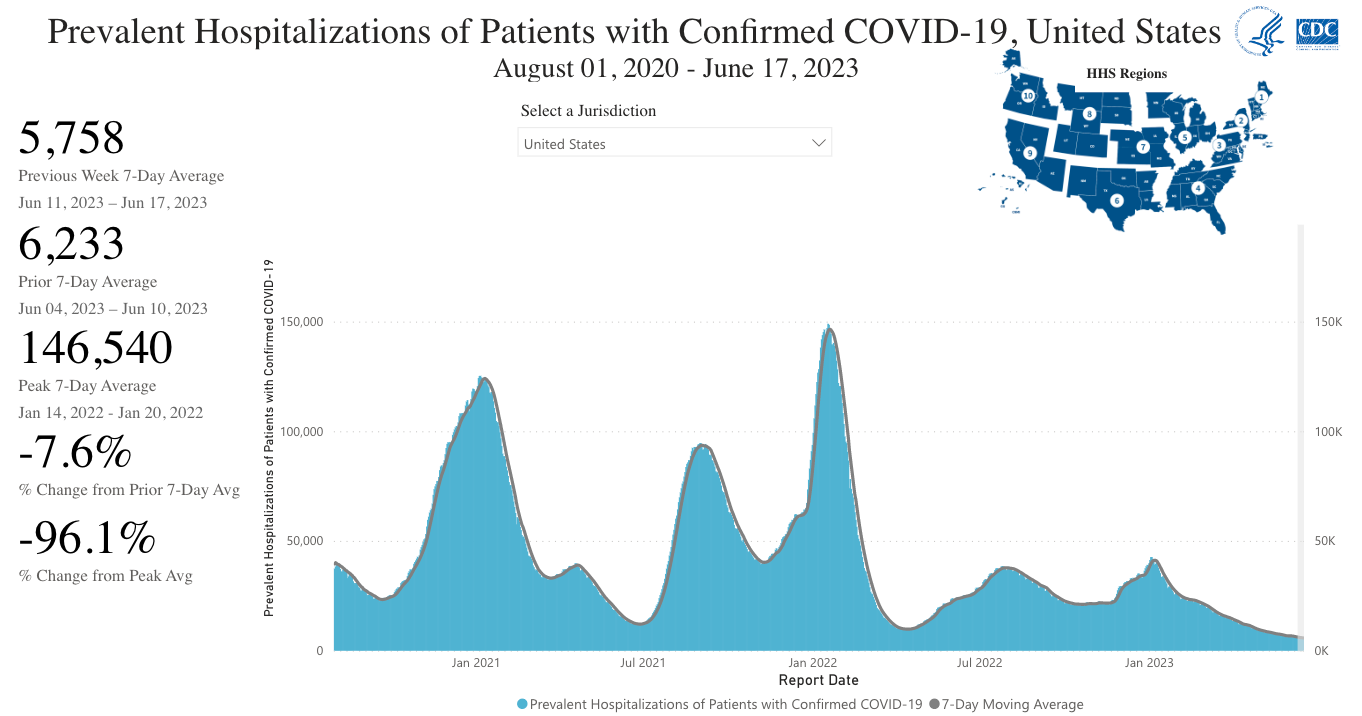
How do I know? The end of the formal Public Health Emergency marked the end of several core data streams that I used to monitor Covid-19 activity. This makes it harder to track the virus, but there are still several sources of useful data. I look at new hospital admissions, emergency room visits, and wastewater data. Where possible, I check these indicators across all ten HHS regions, because sometimes emerging, local trends can get lost in the big picture. I also keep an eye on new variants, which are a common source of new waves.
Not much happening with RSV, influenza, or seasonal coronaviruses.
Hand, foot and mouth disease (HFMD) is common in summertime. HFMD spreads very easily from person to person, and causes painful blisters in the mouth, on the palms of the hands, and the sores of the feet. If you’ve ever had a kid in daycare, you know this scourge. I can’t find any good sources of surveillance data for HFMD, but this time of year it tends to go around.
Some data sources show parainfluenza and adenovirus ticking up, but our disease surveillance for those bugs is not great so it’s hard to get a good read. Parainfluenza causes cough, runny nose, and fever. Adenovirus causes a range of illnesses, including respiratory infections, conjunctivitis, and gastrointestinal symptoms. Both spread from person to person through droplets and close contact.
Stomach bugs
Foodborne illness is common this time of year, especially around holidays like the 4th of July, when outdoor picnics, potlucks, and barbecues are common. One common scenario is leaving food out too long in the hot sun. If you’re having a party and will be distracted, I recommend setting a timer or alarm to remind yourself to put foods away. If you need a refresher on safe food handling, FDA has some tips.
I already see evidence of increased foodborne illness in the surveillance data — E. coli activity is high. It usually peaks in late July.
Norovirus activity is low.
Food recalls
The following foods are being recalled because they are contaminated. Please check your cupboards and throw out any of these items:
- Many frozen fruit items sold at multiple major retailers have been recalled. At this point, consider just throwing out all your store-bought frozen fruit. Or check these lists for the full accounting: pineapple, multiple, multiple, DayBreak blend.
- Gold Medal flour, bleached and unbleached all purpose (more info)
- Sophelise cheese and Tobasi cheese sold in Massachusetts and New York (more info)
In other news
- Four people in Sarasota County, Florida and one person in Cameron County, Texas became infected with malaria in the United States. Locally-acquired (or autochthonous, in epi-speak) malaria has not been reported in the U.S. since 2003. I do not expect these clusters to become widespread problems, but it’s important for clinicians in those areas to keep malaria in mind as a possible diagnosis for people with flu-like symptoms.
- Mpox activity remains low. From June 1 until June 21 there were 21 cases reported, compared to 417 reported in the same period last year.
- Last month, I asked readers whether they would be interested in a regional version of my This week in outbreaks series. Around 77% of respondents said they would, so I’ll give this some serious thought. Thanks for your feedback! Feel free to leave other (courteous) feedback in the comments.